South Korea: HD Hyundai Heavy Industries Migrant Workers Expand Struggle Against Wage Cuts and Bad Contracts
An Attack on Migrant Workers is an Attack on All Workers
By Workers' Revolutionary Party (Preparatory Group), RCIT Section in South Korea, 28.06.2026, https://blog.wrpkorea.org/
The struggle of migrant workers at HD Hyundai Heavy Industries in Ulsan is steadily expanding. Beginning as resistance against a contract that effectively cuts wages, this struggle is developing into a joint fight of Korean and migrant workers, and is linking up with solidarity actions across the country.
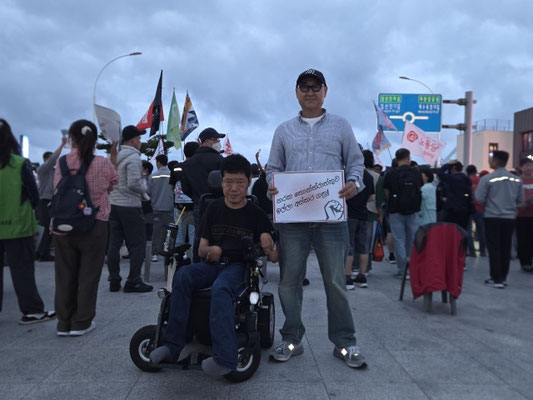
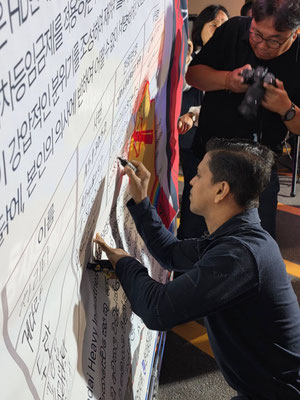
The struggle began on June 13 at a migrant workers' rally held at the Ulsan Migrant Community Center. Sri Lankan migrant workers stepped forward and collectively declared they would refuse the unjust contract and take up the fight together. Some workers stated, "Even if we don't see immediate results, we will fight for the migrant workers who will come to Korea in the future," expressing their firm resolve.
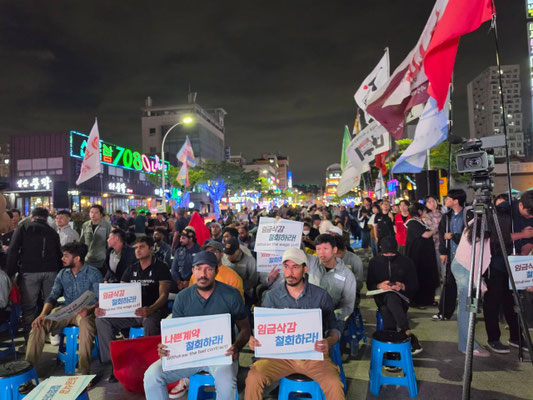
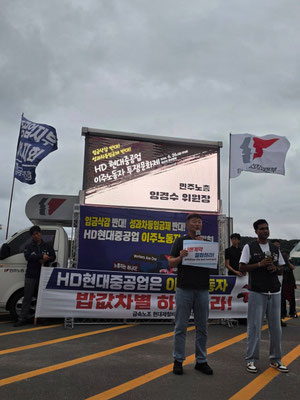
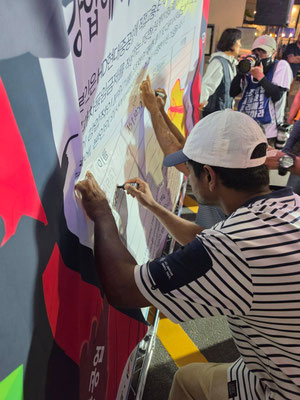
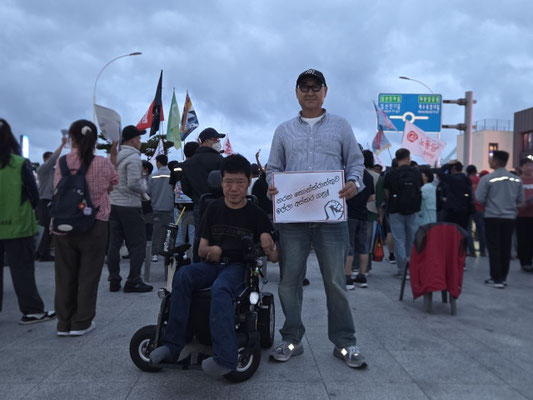
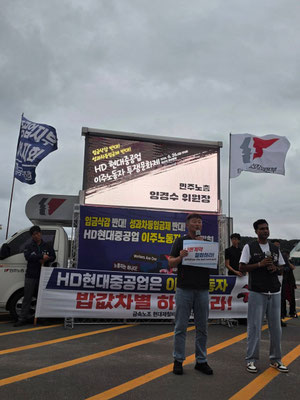
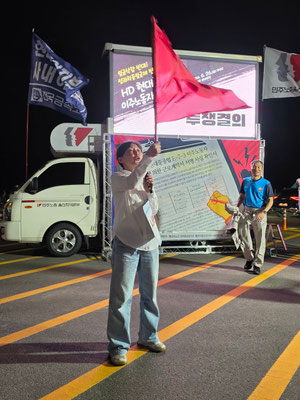
On June 17, activists held a street campaign in front of the Ulsan Regional Employment and Labor Office, followed by a demonstration and rally. Participants marched denouncing HD Hyundai Heavy Industries' wage-cutting policies and discriminatory treatment, with the rally continuing until 9 PM. Workers declared they would "fight to the end" and showed no intention of backing down.
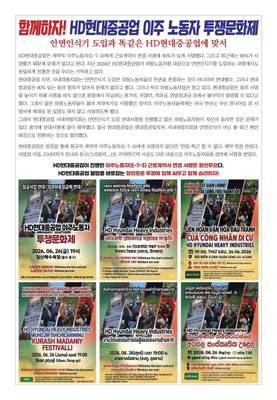
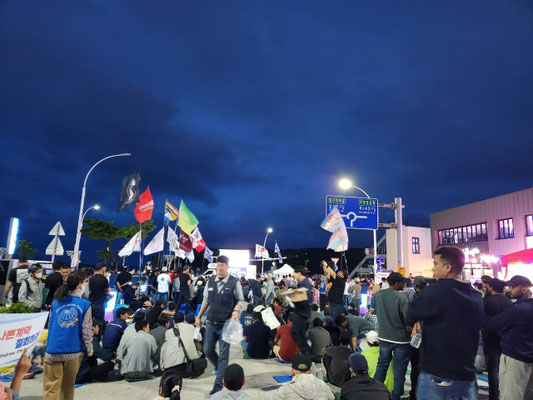
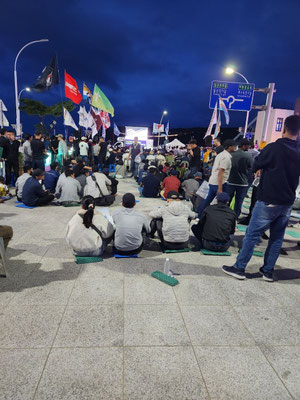
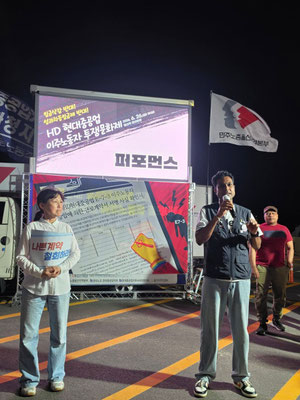
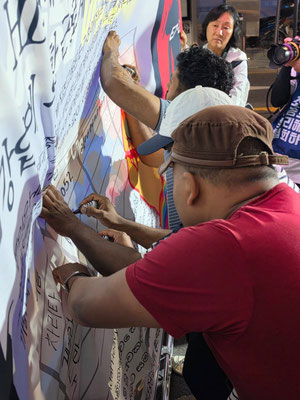
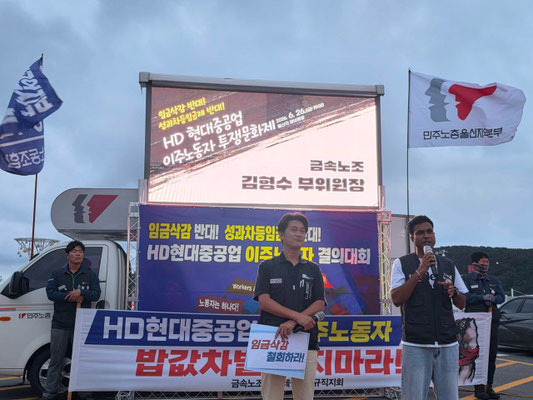
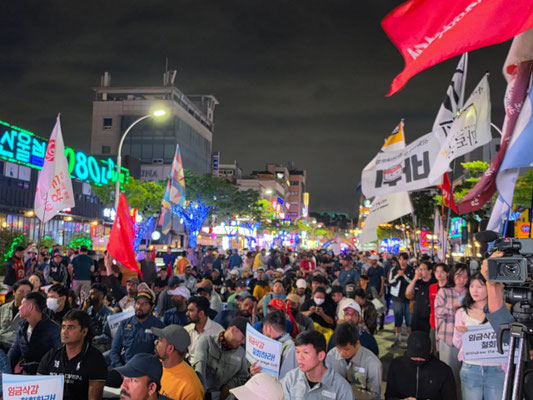
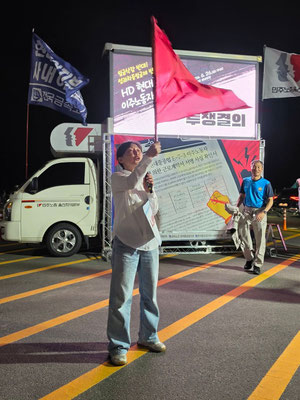
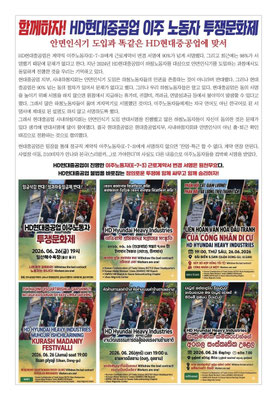
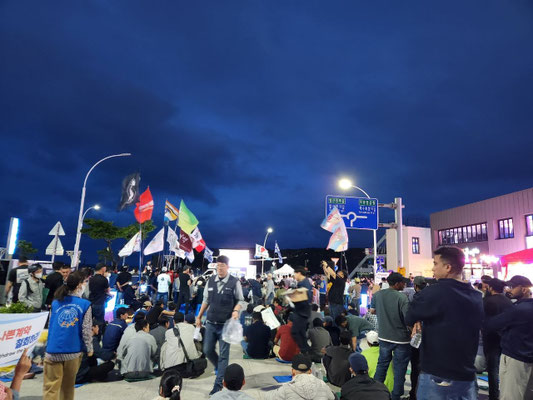
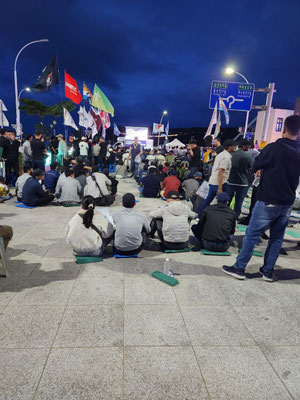
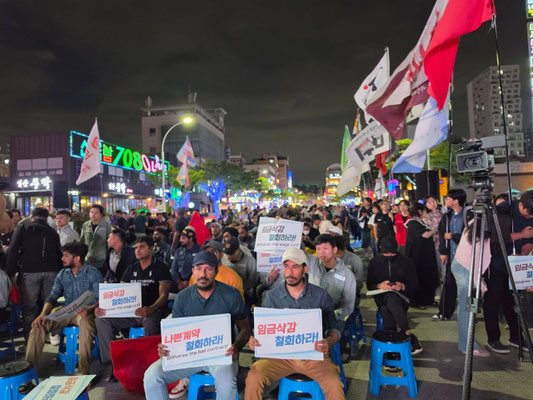
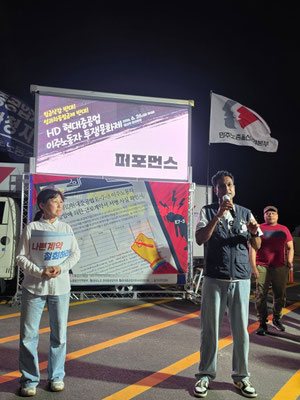
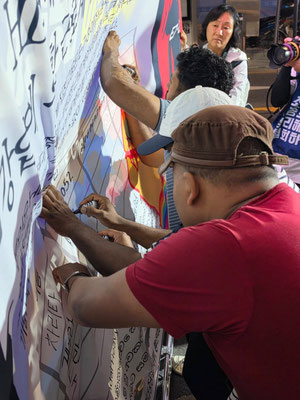
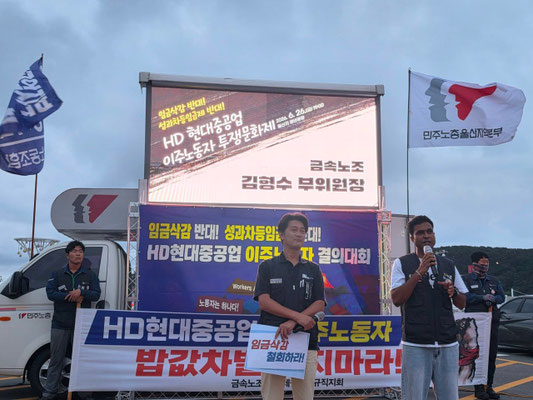
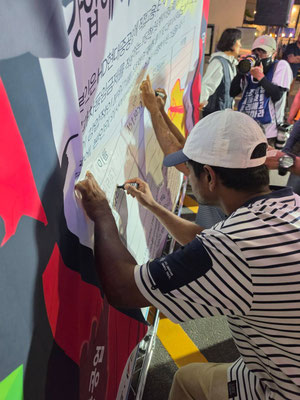
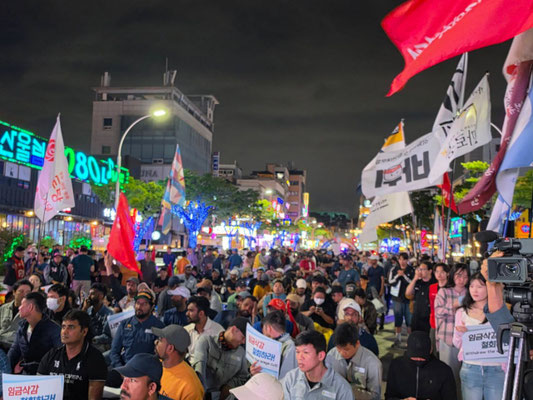
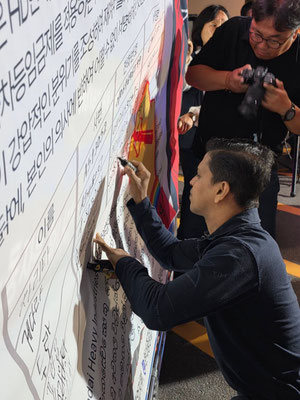
On the evening of June 26, starting at 6 PM, a migrant workers' cultural struggle festival was held at Youth Plaza, Ilsan Beach, Dong-gu, Ulsan. Although originally planned for two hours, the event ran far longer than scheduled as workers continued to take the floor and speak.
Approximately 300 migrant workers from Sri Lanka, Vietnam, Nepal, and other countries participated in the event. Participants emphasized that despite their different nationalities, they are all workers on the same shop floor, and called for unity.
Workers who spoke at the rally strongly condemned the company, saying "This contract makes no sense," "HD Hyundai does not respect workers," and "We will fight to the very end."
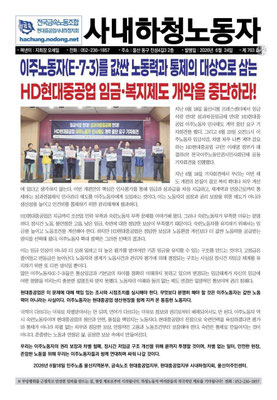
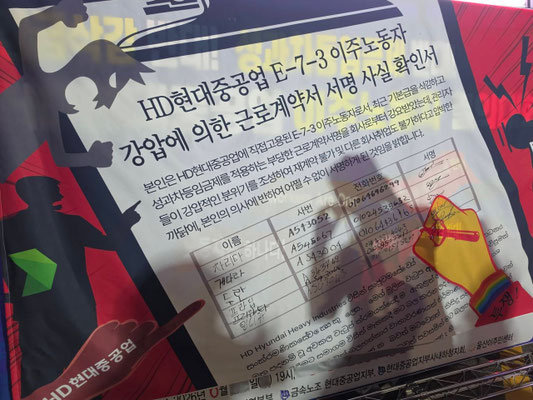
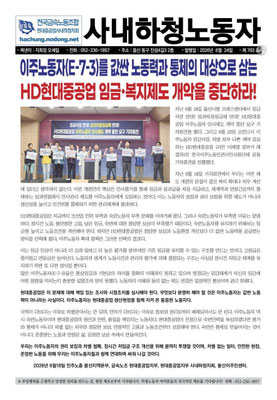
At the heart of this struggle is the company's deceptive practice of imposing an effective wage cut while ignoring workers' demands for a simple renewal of existing contract terms. Workers demanded a straightforward renewal without welfare clauses — keeping conditions as they were — but the company pretended to accept this while drastically cutting base wages and inserting new performance-differentiation clauses. While publicly advertising the removal of meal cost deductions, the company in reality took back even more through cuts to the base wage, deceiving migrant workers in the process.
The company announced it would stop deducting meal costs but instead cut base wages by 168,400 won.
As a result, workers are actually receiving less pay than before:
* Base wage cut by 168,400 won
* Monthly pay reduced by 175,450 won when there is no overtime
* Monthly pay reduced by 208,753 won based on 30 hours of overtime
In the end, workers lose 170,000 to 210,000 won every month.
This is nothing more than replacing a meal deduction with a wage cut.
The structure of this new contract is even more insidious. By inserting new clauses emphasizing performance differentiation, the company is deliberately fostering competition among migrant workers. Discriminatory structures in overtime and performance bonuses have also been kept intact. This effectively institutionalizes an exploitative structure that permanently locks migrant workers into a pool of low-wage labour that can be adjusted at any time.
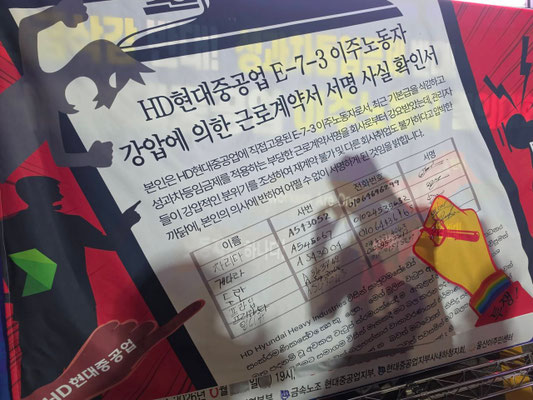
Workers are raising not only the meal cost issue, but also performance bonus discrimination against directly employed migrant workers, the introduction of a performance-tiered wage system, and pressure around contract renewals. The reality that refusing to sign the new contract risks denial of renewal and loss of residency status is being criticized as a deliberate exploitation of migrant workers' vulnerable position.
Currently, the Korean shipbuilding industry is so heavily dependent on migrant workers that production would be difficult without them. In some in-house subcontracting firms, migrant workers account for 60 to 80 percent of the total workforce, and at major shipyards including HD Hyundai Heavy Industries, thousands of migrant workers serve as the core labour force on the shop floor.
This struggle is set to culminate in a National Migrant Workers Rally to be held in front of the main gate of HD Hyundai Heavy Industries on July 5. Migrant workers from across the country plan to gather and take collective action demanding the withdrawal of wage cuts and the guarantee of labour rights.
Commentary
This struggle is a rare example of migrant workers in South Korea organizing themselves and taking to the streets — and as such, it carries historical significance. Until now, large-scale direct struggles by migrant workers in South Korea have been virtually non-existent. Amid language barriers, precarious residency status, and the difficulties of organizing, migrant workers have long been trapped in a structure where speaking out against unjust treatment was nearly impossible. In this context, the fact that the workers directly affected have stepped forward to fight against discrimination and exploitation makes this struggle all the more deserving of the highest recognition. In particular, the fact that migrant workers have risen in direct resistance against capital's attempt to permanently fix them as a source of cheap labour in the shipbuilding industry could mark an important starting point for a new current in the migrant labour movement in South Korea.
This situation is not a problem limited to HD Hyundai Heavy Industries alone. It is an event that lays bare the reality of South Korean imperialism the structural exploitation of migrant workers through the collusion of state power and big capital. The government has expanded the use of migrant labour under the pretext of addressing labour shortages, but corporations are exploiting the precarious residency status and vulnerable position of migrant workers to impose wage cuts and discriminatory working conditions. The state, by turning a blind eye to this structure or providing it with institutional backing, plays the role of an accomplice enabling capitalist exploitation.
Korean capitalism is using migrant workers as cheap labour to drive down labour costs, and by forcing the most vulnerable workers to bear the burden first, it is rolling back working conditions for all workers. Discrimination and exploitation of migrant workers is ultimately an attack on all workers.
Dividing workers by nationality, visa status, and language to set them against each other is nothing but a strategy of capital for profit. To fight back, Korean workers and migrant workers must unite as a single working class and strengthen internationalist solidarity.
This struggle must be developed into a joint working-class fight against the exploitative structure of Korean capitalism — and against the migrant labour exploitation structure of South Korean imperialism. Only internationalist solidarity can overcome this structure of exploitation.
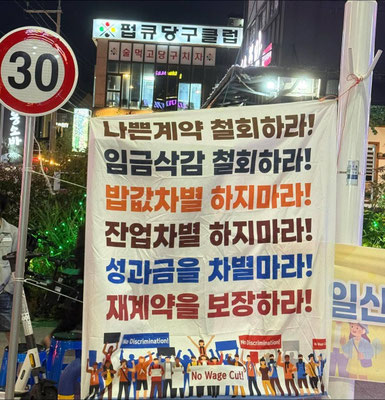
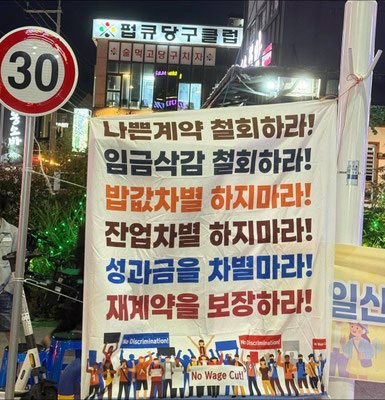
Withdraw the bad contract!
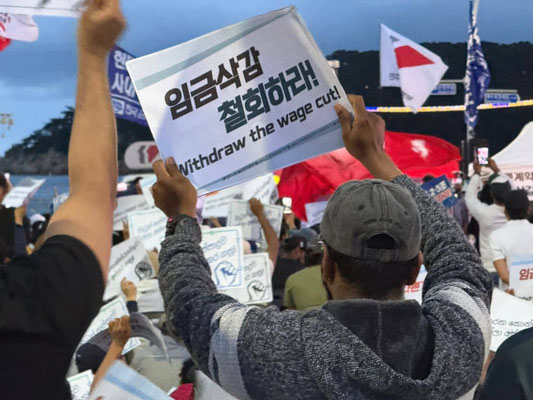
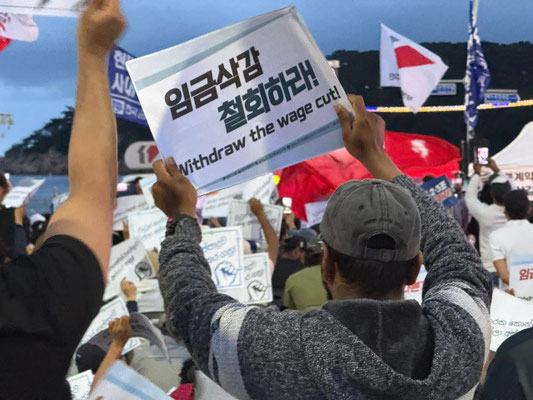
Withdraw the wage cuts!
No meal cost discrimination!
No overtime discrimination!
No performance bonus discrimination!
Guarantee contract renewals!
Migrant workers are equal workers!
Equal work, equal pay!
Workers' rights are not something to be conceded. Only the unity of workers can defend wages and rights — and the power to overcome the exploitative structure of Korean capitalism will be built through the unity and struggle of the working class itself, through joint struggle between Korean and migrant workers, and through the strengthening of internationalist workers' solidarity.

HD현대중공업 이주노동자들, 나쁜계약, 임금삭감에 맞서 투쟁 확대
"이주노동자에 대한 공격은 모든 노동자에 대한 공격이다"
작성자: 노동자혁명당(준) 날짜, 6월 28, 2026, https://blog.wrpkorea.org
울산 HD현대중공업 이주노동자들의 투쟁이 점차 확대되고 있다. 임금을 실질적으로 삭감하는 계약에 반대하며 시작된 이번 투쟁은 한국인 노동자와 이주노동자의 공동투쟁으로 발전하고 있으며, 전국적인 연대로 이어지고 있다.
투쟁은 6월 13일 울산 이주주민센터에서 열린 이주노동자 결의대회에서 시작됐다. 이날 스리랑카 이주노동자들은 앞에 나와 "이러한 부당한 계약을 거부한다"며 집단적으로 투쟁에 나설 것을 선언했다. 일부 노동자들은 "비록 우리에게 당장 좋은 결과가 오지 않더라도 앞으로 한국에 올 이주노동자들을 위해 싸우겠다"며 결의를 밝혔다.
이어 6월 17일에는 울산고용노동지청 앞에서 선전전을 진행한 뒤 거리행진과 집회를 열었다. 참가자들은 HD현대중공업의 임금삭감 정책과 차별적인 처우를 규탄하며 행진을 이어갔고, 집회는 밤 9시까지 계속됐다. 노동자들은 "끝까지 투쟁하겠다"며 물러서지 않겠다는 의지를 밝혔다.
6월 26일 오후 6시부터 울산 동구 일산해수욕장 청년광장에서는 이주노동자 투쟁문화제가 열렸다. 집회는 당초 2시간으로 예정됐지만 현장 노동자들의 발언이 계속 이어지면서 예정보다 훨씬 길게 진행됐다.
이날 집회에는 스리랑카, 베트남, 네팔 등 여러 나라의 이주노동자 약 300명이 함께했다. 참가자들은 국적은 다르지만 같은 현장에서 일하는 노동자라는 점을 강조하며 단결을 호소했다.
발언에 나선 노동자들은 "이런 계약은 말이 되지 않는다", "HD현대는 노동자를 존중하지 않는다", "우리는 끝까지 투쟁할 것이다"라고 외치며 회사를 강하게 규탄했다.
이번 투쟁의 핵심은 회사가 단순 재계약을 요구하는 노동자들의 목소리를 외면한 채, 교묘한 방식으로 실질적인 임금삭감을 강요했다는 데 있다. 노동자들은 복지 조항 없이 기존 조건 그대로 재계약할 것을 요구했지만, 회사는 이를 받아들이는 척하면서 기본급을 대폭 삭감하고 성과 차등 조항을 새롭게 삽입했다. 겉으로는 식비 공제를 없앤다고 홍보했지만, 실제로는 그 이상을 기본급에서 도로 빼앗는 방식으로 이주노동자들을 기만한 것이다.
회사는 식비 공제를 중단한다고 홍보했지만, 대신 기본급을 **16만 8천400원 삭감**했다.
그 결과 노동자들이 실제로 받는 임금은 오히려 줄어들었다.
* 기본급 168,400원 삭감
* 잔업이 없을 경우 월급 175,450원 감소
* 잔업 30시간 기준 월급 208,753원 감소
결국 노동자들은 매달 17만~21만 원의 임금을 잃게 된다.
이는 식비 공제를 임금삭감으로 바꿔치기한 것에 불과하다.
더 나아가 이번 계약의 구조는 더욱 교묘하다. 성과 차등을 강조하는 새로운 조항을 삽입해 이주노동자들 사이에 경쟁을 조장하고 있다. 잔업과 성과금에서도 이주노동자를 차별하는 구조를 그대로 유지했다. 이는 결국 이주노동자를 언제든지 임금 조정이 가능한 저임금 노동력으로 고정시키는 착취 구조를 제도화한 것이다.
노동자들은 식비 문제뿐 아니라 직접고용 이주노동자들에 대한 성과급 차별, 성과차등임금제 도입, 재계약 압박 등도 함께 문제 삼고 있다. 새로운 계약에 서명하지 않으면 재계약 거부와 체류자격 상실의 위험에 놓이는 현실은 이주노동자들의 취약한 처지를 악용한 것이라는 비판이 제기되고 있다.
현재 한국 조선업은 이주노동자 없이는 생산이 어려울 정도로 이주노동자의 비중이 매우 높다. 일부 사내하청 업체에서는 이주노동자가 전체 노동자의 60~80%를 차지하고 있으며, HD현대중공업을 비롯한 주요 조선소에서도 수천 명의 이주노동자들이 생산현장의 핵심 노동력으로 일하고 있다.
이러한 투쟁은 오는 **7월 5일 HD현대중공업 정문 앞에서 열리는 전국 이주노동자대회**로 이어질 예정이다. 전국 각지의 이주노동자들이 참가해 임금삭감 철회와 노동권 보장을 요구하는 공동행동을 벌일 계획이다.
노동자혁명당(준) 논평
이번 투쟁은 남한에서 이주노동자들이 스스로 조직해 거리로 나선 보기 드문 사례로, 그 자체로 역사적인 의미를 지닌다. 그동안 남한에서 이주노동자들의 대규모 직접 투쟁은 거의 없었다. 언어 장벽, 불안정한 체류자격, 조직의 어려움 속에서 이주노동자들은 부당한 처우를 받으면서도 목소리를 내기 어려운 구조 속에 놓여 있었다. 그런 점에서 이번 투쟁은 당사자인 이주노동자들이 직접 나서서 차별과 착취에 맞선 투쟁이라는 점에서 더욱 높이 평가받아야 한다. 특히 조선업에서 이주노동자들을 저임금 노동력으로 고착시키려는 자본의 시도에 맞서 당사자들이 직접 저항에 나섰다는 사실은, 남한 이주노동 운동의 새로운 흐름을 만들어내는 중요한 출발점이 될 수 있다.
이번 사태는 HD현대중공업 한 기업만의 문제가 아니다. 이는 한국 자본주의 국가 권력과 대자본이 결탁해 이주노동자를 구조적으로 착취하는 방식, 즉 남한 제국주의의 실상을 적나라하게 드러낸 사건이다. 정부는 인력난 해결을 이유로 이주노동자를 확대해 왔지만, 기업들은 이주노동자의 불안정한 체류자격과 열악한 지위를 이용해 임금삭감과 차별적인 노동조건을 강요하고 있다. 국가는 이 구조를 묵인하거나 제도적으로 뒷받침함으로써 자본의 착취를 가능하게 만드는 공범 역할을 하고 있다.
한국 자본주의는 이주노동자를 값싼 노동력으로 활용해 노동비용을 낮추고, 가장 취약한 노동자부터 희생을 강요하는 방식으로 전체 노동자의 노동조건을 후퇴시키고 있다. 이주노동자에 대한 차별과 착취는 결국 모든 노동자에 대한 공격이다.
노동자들을 국적과 비자, 언어로 갈라 경쟁시키는 것은 자본의 이윤을 위한 전략일 뿐이다. 이에 맞서기 위해서는 한국인 노동자와 이주노동자가 하나의 노동계급으로 단결하고 국제주의적 연대를 강화해야 한다.
이번 투쟁을 한국 자본주의의 노동착취 구조, 나아가 남한 제국주의의 이주노동 착취 구조에 맞선 노동계급 공동투쟁으로 발전시켜야 한다. 국제주의적 연대만이 이 착취 구조를 넘어설 수 있다.
**나쁜 계약 철회하라!**
**임금삭감 철회하라!**
**밥값 차별 하지 마라!**
**잔업 차별 하지 마라!**
**성과금 차별 하지 마라!**
**재계약을 보장하라!**
**이주노동자도 동등한 노동자다!**
**같은 노동, 같은 임금!**
노동자의 권리는 양보의 대상이 아니다. 노동자의 단결만이 임금과 권리를 지켜낼 수 있으며, 한국인 노동자와 이주노동자의 공동투쟁, 그리고 국제주의적 연대만이 이 착취 구조를 넘어설 수 있다.공동투쟁, 국제주의적 노동자 연대를 강화하여 자본의 임금삭감과 차별 정책에 맞서 싸울 것이다.
임금삭감을 중단하라!
나쁜 근로계약을 철회하라!
이주노동자도 동등한 노동자다!
같은 노동, 같은 임금!
노동자의 권리는 양보의 대상이 아니다. 노동자의 단결만이 임금과 권리를 지켜낼 수 있으며, 한국 자본주의의 노동착취 구조를 극복할 수 있는 힘도 노동계급 자신의 단결과 투쟁 속에서 만들어질 것이다.