
China's transformation into an imperialist power
A study of the economic, political and military aspects of China as a Great Power
By Michael Pröbsting
Contents
A study of the economic, political and military aspects of China as a Great Power
What are the criteria for an imperialist state?
China’s race to a world leading economy
China’s Monopolies
Exploitation and super-exploitation of the working class
Capital export as bond and loan capital
Capital export as Foreign Direct Investment
A note on Hong Kong’s role in Foreign Direct Investment
Where is China investing abroad?
Super-exploitation of the semi-colonies
China’s military forces
The struggle for control over the South China (or East) Sea
The approach of the Bolshevik-Communists towards possible wars involving China
Why did China’s rulers succeed in becoming imperialist where others failed?
Notes

Note from the Editor: The following document is based on a chapter of the RCIT’s upcoming book “The Great Robbery of the South”. In this book, the author, Michael Pröbsting, analyzes the continuity and changes in the super-exploitation of the semi-colonial world by monopoly capital. He deals with the implications for a contemporary Marxist Theory of Imperialism. In this context comrade Pröbsting studied the formation of China as an imperialist power and its background since the restoration of capitalism in the early 1990s. The RCIT will publish this book this autumn.
In this article we want to analyze the transformation of China from a Degenerated Workers State into a capitalist and finally an imperialist power. It would of course exceed the limits of this document to deal with the whole history of China’s economy in the past decades. We will instead focus on the question which is of enormous importance for Marxists to develop correct world perspectives and revolutionary tactics in the international class struggle: Should China be considered as an imperialist power or rather as a semi-colonial country which is super-exploited by imperialism?
We in the RCIT are convinced that China is an emerging imperialist power and not a semi-colonial power. [1] In that it is an important and historically exceptional case of Southern countries. Usually – as we will show in our upcoming book The Great Robbery of the South – the countries of the South were not able to develop into an imperialist power. They rather suffered an increasing super-exploitation of the old imperialist powers in Northern America, Western Europe, Japan and Australia.
However, China’s development is different. It has developed into an imperialist state recently in the late 2000s. Compared to the biggest imperialist power – the USA – it is still weak (as many other imperialist countries are). As a new, i.e. late-coming, imperialist country it bears various peculiar features, including super-exploitation by foreign monopoly capital. These features are however outweighed by the increasing strength of China’s domestic bourgeoisie. In particular we have to emphasize the role of China’s monopolies in global production, trade and of capital export. Related to this is China’s undisputable emergence as a political and military power in international politics.
The main reasons for China’s successful development into an imperialist power were:
i) The continuing existence of a strong, centralized Stalinist bureaucracy which could suppress the working class and ensure its super-exploitation.
ii) The historic defeat of China’s working class in 1989 when the bureaucracy bloody crushed the mass uprising at the Tiananmen Square and in the whole country.
iii) The decline of US imperialism which opened the space for new powers.
What are the criteria for an imperialist state?
Before we give a concrete overview of the development of Chinese imperialism, let us try to give a definition of an imperialist state „…without forgetting the conditional and relative value of all definitions in general, which can never embrace all the concatenations of a phenomenon in its full development…“ – as Lenin put it so wisely. [2]
Lenin described in 1916 in a key article as the essential characteristic of imperialism the formation of monopolies which are dominating the economy. Related to this he pointed out the fusion of banking and industrial capital into financial capital, the increasing of capital export in addition to commodity export and the fight for the possession of colonies respectively spheres of influence:
“We have to begin with as precise and full a definition of imperialism as possible. Imperialism is a specific historical stage of capitalism. Its specific character is threefold: imperialism is monopoly capitalism; parasitic, or decaying capitalism; moribund capitalism. The supplanting of free competition by monopoly is the fundamental economic feature, the quintessence of imperialism.”[3]
He goes on to explain the monopolist essence of imperialism:
“Monopoly manifests itself in five principal forms: (1) cartels, syndicates and trusts—the concentration of production has reached a degree which gives rise to these monopolistic associations of capitalists; (2) the monopolistic position of the big banks—three, four or five giant banks manipulate the whole economic life of America, France, Germany; (3) seizure of the sources of raw material by the trusts and the financial oligarchy (finance capital is monopoly industrial capital merged with bank capital); (4) the (economic) partition of the world by the international cartels has begun. There are already over one hundred such international cartels, which command the entire world market and divide it “amicably” among themselves—until war redivides it. The export of capital, as distinct from the export of commodities under non-monopoly capitalism, is a highly characteristic phenomenon and is closely linked with the economic and territorial-political partition of the world; (5) the territorial partition of the world (colonies) is completed.”
As a result we can say that the characteristic of an imperialist power has to be seen in the totality of its economic, political and military position in the global hierarchy of states. Thus a given state must be viewed not only as a separate unit but first and foremost in its relation to other states and nations. An imperialist state usually enters a relationship with other states and nations whom it oppresses in one way or another and super-exploits – i.e. appropriates a share of its produced capitalist value. Again this has to be viewed in its totality, i.e. if a state gains certain profits from foreign investment but has to pay (debt service, profit repatriation etc.) much more to other countries foreign investment, this state can usually not being considered as imperialist. Finally we want to stress the necessity of considering the totality of a state’s economic, political and military position in the global hierarchy of states. Thus we can consider a given state as imperialist even it is economically weaker but possess a relatively strong political and military position (like Russia before 1917 and in the early 2000s). Such a strong political and military position again can be used to oppress other countries and nations and to appropriate capitalist value from them.
Viewing a state in the context of the global imperialist order is also important because particularly smaller imperialist states (like Australia, Belgium, Swiss, the Netherlands, Austria, the Scandinavian countries etc.) are obviously not equal with the Great Powers but subordinated to them. They could not play an imperialist role alone. But despite being not equal with the Great Powers – by the way even amongst the Great Powers there is constant rivalry and no equality – these smaller imperialist states are not super-exploited by them. As a result while there is no or no significant value transfer from these smaller imperialist states towards the Great Powers, there is a significant value transfer from semi-colonies to these smaller imperialist states. They ensure this privileged position by entering economic, political and military alliances with the Great Powers (NATO, EU, OECD, IMF, World Bank, WTO, various “Partnerships” etc.)
In short we define an imperialist state as follows: An imperialist state is a capitalist state whose monopolies and their state apparatus have a position in the world order where they first and foremost dominate other states and nations. As a result they gain extra-profits and other economic, political and/or military advantages from such a relationship based on super-exploitation and oppression.
We think such a definition of an imperialist state is in accordance with Lenin’s brief definition which gave in his polemic against imperialist economism:
„… imperialist Great Powers (i.e., powers that oppress a whole number of nations and enmesh them in dependence on finance capital, etc.)…“ [4]
Before we move to the concrete analysis we need to add two remarks. First, for the definition of the class character of a given state it is important also to view it from a historic perspective. For example an imperialist state can lack temporarily this or that essential feature of imperialism because of specific historic circumstances. For example after the Second World War, Austria was first occupied by US, British, French and Russian troops till 1955 and later its capital export was underdeveloped. However we Marxists rejected the position of the Austrian Stalinist party that the country had become a semi-colony of Germany. Why? For several reasons: Austria had a strong imperialist past (the Habsburg Empire oppressing many nations till 1918, after this a strong banking capital with many links to Eastern Europe etc.). Given its close integration into the world imperialist camp it could after some time regain a position where it systematically and significantly super-exploited other nations. Another example might be Germany or Japan after the WWII which despite certain elements of military occupation and restrictions to its own military capacities obviously remained an imperialist power. So, when analyzing an imperialist state we have to view not only a given moment, but the direction of development. We have to bear in mind Trotsky’s remark: „Dialectic training of the mind, as necessary to a revolutionary fighter as finger exercises to a pianist, demands approaching all problems as processes and not as motionless categories.“ [5]
Secondly, we want to answer a possible criticism of our position that China is an imperialist state. One could ask: how could a country become imperialist if it was before – when it was capitalist – a semi-colony? Of course it is true that usually semi-colonies don’t transform into imperialist countries. And indeed one could say that China had – after capitalism was restored around 1992 – for a number of years more features of a semi-colony than of an imperialist state. However it would be completely un-dialectically to exclude such a jump in a country’s development under certain circumstances. There have also been examples in history of such a “jump”. Czechoslovakia was a colony of the Austrian Habsburg Empire for centuries before 1918 but when it became independent, Communists (including Lenin and Trotsky) recognized it as an imperialist state. By the way, such a kind of dialectical development can also take place in the other direction – i.e. a “jump” backward when an imperialist state becomes a semi-colony. Lenin discussed such a potential development in his polemic against imperialist economism when he spoke about the possibility of the transformation of an imperialist war into a just war of national defense.
China’s race to a world leading economy
Since the former bureaucracy introduced capitalism in the early 1990’s Chinese capitalism has grown rapidly. [6] In terms of the total output measured by the Gross Domestic Product China’s share has grown massively in the past two decades. While China produced in 1991 4.1% of the global output, this figure rose to 14.3% in 2011. This makes it the world second-biggest economy. At the same time the USA’s share declined from 24.1% to 19.1% in 2011. [7] Graph 1 gives an overview of the changing share of the world 15 biggest economies in the past three decades.
Graphik 1 Share of Global Economic Output [8]
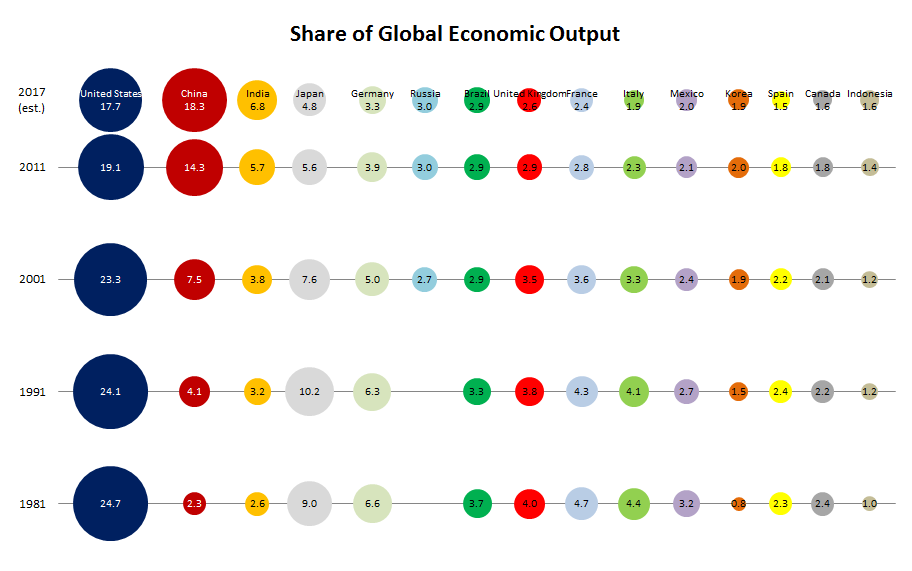
In manufacturing – the core sector of the capitalist value production – China has even become the world’s leading economy. By this it ended the US’s 110-year leading position as the largest commodities producer. By 2011 a fifth of world’s manufacturing came from China (19.8%) while 19.4% originated in the US economy. [9]
In one of the world’s main industries – crude steel – nearly half of the global production (48.6%) came from China in 2011. [10]
Parallel to this it has become the world’s leading exporter. Graph 2 gives an overview over China’s recent rapid catching-up process.
Graphik 2 China’s Economic Performance [11]

In Graph 3 we can see not only China’s increasing share in the world export’s but also an interesting historical comparison with the advance of the USA in the first quarter of the 20th century.
Graphik 3 Share of global manufacturing exports; USA and Britain 1906-29 and China 2000-09 [12]

The World Bank and the Chinese Development Research Center of the State Council pointed out in a joint study, that China has also achieved a number of other advances in its desire to modernize its economy: “China is home to the world’s second-largest highway network, the world’s 3 longest sea bridges, and 6 of the world’s 10 largest container ports.” [13]
China’s economic strength is also reflected in its low level of indebtedness to the global financial market. Its external debt stocks as a share of the Gross National Income stands at only 9.3% and its debt service to exports is 2.5%. [14] Compare this to the much higher levels of other industrialized countries from the South and the general assessment of UNCTAD (in Graph 4) which shows that the so-called “Upper middle-income countries” paid between 2005-2010 around 40% of their total export income to service their debts to the imperialist monopolies.
Graphik 4 External debt service-to-export ratio 2005-2010 [15]

In fact it is rather the other way round as we will see below: other countries are indebted to China’s financial capital! So we also see from this angle that China is not a dependent, super-exploited semi-colony but rather an emerging imperialist power.
Of course this must not overlook the still existing gap between the old imperialist economies and China’s labor productivity. While the US’s and China’s manufacturing output is nearly the same, the US-American capitalists produced this output in 2010 with 11.5 million workers while their Chinese rivals needed 100 million. [16] Similarly China technological residual behind the old imperialist economies is also indicated in its substantially lower employment of machinery in the production process. This is reflected in China’s level of capital stock per worker which is less than a tenth of the U.S. (converted at market exchange rates). [17]
However because of its enormous size, a unified state apparatus with a massive state capitalist sector and a super-exploited working class the Chinese monopoly bourgeoisie manages not only to play a role on the world market but also to play a leading role in the world capitalist economy. Marx remarked in Capital Vol. III that in the process of capitalist accumulation not only the rate of profit but first and foremost the mass of profits is decisive.
„And thus the river of capital rolls on (…), or its accumulation does, not in proportion to the rate of profit, but in proportion to the impetus it already possesses.“ [18]
China’s Monopolies
Despite significant Western and Japanese foreign investment in China, the ruling class in Beijing has avoided the dominance of its economy by foreign monopolies. Quite the opposite, it has developed strong Chinese monopolies who today have become “global players” – to use a favorite category of the bourgeois economists for whom the mysteries of the law of value makes them thinking of the capitalist economy as gambling in a casino.
This becomes obvious if one looks at the Chinese monopolies advance in the list of the biggest global corporations. In The Forbes Global 2000 – a list of the biggest, most powerful listed companies in the world – China already ranks as third biggest country. 121 companies on this list are from China and only the USA (524 companies) and Japan (258 companies) provide more members. These 121 Chinese monopolies have an aggregate profit of $168 billion (which is 7% of the total profit of the 2000 biggest monopolies. [19]
In the Fortune Global 500 – another list of the world’s biggest corporation which uses different criteria – we can see the same dynamic of China’s massive and growing place amongst the world’s super-monopolies. Amongst the biggest 10 global corporations – the super-super monopolies so to say – three are Chinese: the petroleum corporations Sinopec and China National Petroleum and the energy corporation State Grid. [20] If one takes the top 500 corporations we see that China already surpassed Japan as the second-biggest country. 73 of these corporations are Chinese, 132 come from the USA, 68 from Japan, and each 32 from France and Germany. (see Table 1)
Tabelle 1. Where are the biggest global Monopolies located? List of the top 10 countries of the Global 500 companies [21]
Rank Country Number of Companies
-----------------------------------------------------------------------
1 United States 132
2 China 73
3 Japan 68
4 France 32
4 Germany 32
6 United Kingdom 26
7 Switzerland 15
8 South Korea 13
9 Netherlands 12
10 Canada 11
The rise of China’s monopolies in the past decade becomes obvious if one looks at their ranking in the same list at the beginning of the century. As we saw while Chinese corporations numbered 72 in the Fortune Global 500 list of 2012, it was only 12 in 2001 (i.e. one sixth). [22]
Again as in world’s output and exports China’s advance was paralleled by a similar decline of the leading position of US imperialism. While in the early 2000 197 corporations amongst the Fortune Global 500 had their headquarters in the USA, this figure was down to 132 in 2012. [23]
The Chinese rulers have created a capitalist class. Today a majority share in China’s output is produced by the private sector. This is reflected in the following figures: According to The World Bank and the Chinese Development Research Center of the State Council the non-state sectors contributed for about 70% of the country’s GDP and employment. The state sector’s share in the total number of industrial enterprises (with annual sales over 5mn RMB) fell from 39.2% in 1998 to 4.5% in 2010. During the same period, the share of State Owned Enterprises in total industrial assets fell from 68.8% to 42.4%, while their share in employment declined from 60.5% to 19.4%. Their share in China’s exports also fell from 57% in 1997 to 15% in 2010. [24]
The Chinese Stalinist bureaucracy created a new indigenous bourgeoisie out of its own ranks since the old Chinese capitalist class was expelled after 1949-52 to Hong Kong, Macao, Taiwan or oversea. Of course it also tries to attract the old Diaspora bourgeoisie but it has no appetite to withdraw from the scene and to hand the economy over to the later. For this reason a process of rapid primitive accumulation was initiated with the result of a growing private capitalist sector as the figures above indicate. However given the huge size of the country’s economy and the – in relation to this – small size of the new Chinese capitalist class, the ruling class made sure that a strong state capitalist sector ensures that China avoids the fate of economic collapse like the former Soviet Union after 1991. Quite the opposite, the state sector operates under the law of value and is the core of the economy and the spearhead for its operation on the world market.
In fact the state capitalist sector is the decisive heart of Chinese imperialism. Today the state owned enterprises are responsible for about 35% of the fixed-asset investments made by Chinese firms. More than two-thirds of Chinese companies in the Global Fortune 500 are state-owned enterprises. The biggest State Owned Enterprises (SOE), excluding banks and insurance companies, are directed via controlling stakes which are owned by a central holding company known as the State-Owned Assets Supervision and Administration Commission (SASAC). Banks and insurance companies are majority owned by other agencies of the state. The banking sector is totally dominated by the state banks while foreign banks hardly play any role. The banking sector is also responsible for half of the whole financial system. If one combines this figure with the government bonds, the state sector provides nearly 2/3 of the financial system. (See Graph 5) Since Lenin developed the category of “state monopoly capitalism”, there has never been a more pure form of state monopoly capitalism than China in the last two decades.
Graphik 5 International Comparison of Ownership Structure of the Banking Sector (2005) and Financial System Structure (2009) [25]

After introducing the law of value in the early 1990s Chinese rulers undertook a massive transformation of the state sector. This was necessary since the task was to transform it from a state bureaucratic into a state capitalist sector. Therefore a massive process of downsizing and restructuring took place in the 1990s where thousands of the State Owned Enterprises went bankrupt and many more were fused into bigger units. (See Graph 7 for the SOE’s declining share in numbers, employment and assets) One of the core institutions of world imperialism – The World Bank – formulates approvingly: “Many SOEs were corporatized, radically restructured (including labor shedding), and expected to operate at a profit. (…) As a result, the profitability of China’s SOEs increased.” [26] According to the official report from the State-owned Assets Supervision and Administration Commission, the biggest 120 state-monopolies (which are mostly in sectors like electricity, petroleum, aviation, banking and telecoms) earned in 2011 net profits of 917 billion yuan ($142 billion). [27]
As a result both the state capitalist and the private capitalist sector could massively increase their profits. In Graph 6 we can see the calculations of two Chinese socialist economist, Zhang Yu & Zhao Feng. They attempt to calculate the profit rate in the Chinese manufacturing industry between 1978 and 2004 from a Marxist point of view. Of course one has to put in mind that before the early 1990s the earnings in the manufacturing industry were not rate of profits in the sense as Marx understood it. Nevertheless the Graph indicates the difficulties of the capitalist restoration process in the 1990s and the upswing of the profit rate from the late 1990s onwards when it nearly tripled.
Graphik 6 The Trend of Rate of Profit in the Chinese Manufacturing Industry, 1978-2004 [28]

In Graph 7 we can see the continuing growth of the profits of the SOE’s and even more of the non-state enterprises. The SOE’s reported average return on equity grew from 2.2% in 1996 to 15.7% percent in 2007, before sliding back somewhat to 10.9 percent in 2009. The return on equity of the non-state enterprises even climbed to more than 20%.
Graphik 7 Size of State-Owned Enterprises and Rate of Return in private and state enterprises in China, 1998-2010 [29]

As we said, these state-owned enterprises are operated as capitalist units. They are mostly stock companies with a majority stake of the state. Their operation according to the law of value is underlined by the fact that they don’t pay the dividends, which have increased since a reform in 2007 to 5-15% of profits, to the finance ministry – the formal majority share holder. They pay them rather into a special budget reserved for financing state enterprises, i.e. to themselves. As The Economist – a leading mouth piece of the Western monopoly capital – put it accurately: “SOE dividends, in other words, are divided among SOEs.” [30]
Unsurprisingly, the top positions in the state-owned enterprises are dominated by the ruling party’s sons and daughters. Two academics, Li-Wen Lin and Curtis J. Milhaupt, have shown in an actual study the very close relations and interweaving of the party, state and the state-owned enterprises. They conclude with justification: “We call the organizational structure of state capitalism as practiced in China a networked hierarchy.” [31]
Exploitation and super-exploitation of the working class
The material basis for China’s leap into an imperialist power was the creation of a massive amount of capitalist value through the huge super-exploitation of its working class. There was hardly any other capitalist power in the history of the 20th century (except the phase of fascism), which could not only exploit its working class but also extract huge extra-profits from the super-exploitation of the majority of the proletariat. This is the “secret” behind the Chinese economic miracle.
After the historic defeat of the Chinese working class delivered by the reactionary Stalinist bureaucracy in June 1989, the working class was massively robbed of its social gains. [32] They successfully introduced the law of value in the economy and transformed the workers into a commodity like in the capitalist world. An author of the China Left Review summarized this fundamental change adequately with the following words:
“The Chinese economy today is capitalist, I have argued, because employment relations have been transformed along capitalist lines. Work unit members have been expropriated; they have lost their membership rights and are now simply contract labor. This fundamental change has allowed Chinese enterprises to act like capitalist enterprises. Freed from long-term responsibilities for their employees, they can now treat labor as a flexible input, which allows them to focus on maximizing profit. This is true not only of private companies, but also of the remaining state-owned enterprises and all of the public-private hybrids in between.” [33]
One of the attacks was the introduction of piece-rate wages where each worker got an individual wage according to his or her individual working results. Another one was the shift from lifetime employment to a system of labor contracts. Under this new system, workers had to sign and renew their contracts with the management annually on an individual basis. Despite long resistance by the workers the state bureaucracy finally succeeded to implement it. So while in 1986 only 6% of the workers in the state-owned enterprises were placed under the contract system, this share increased to a quarter of all SOE workers in 1994. [34]
Another decisive instrument was the utilization of the old household registration system which was set up by the Stalinist bureaucracy in 1958. According to this system (called hukou in China) “residents were not allowed to work or live outside the administrative boundaries of their household registration without approval of the authorities. Once they left their place of registration, they would also leave behind all of their rights and benefits. For the purpose of surveillance, everyone, including temporary residents in transit, was required to register with the police of their place of residence and their temporary residence. By the 1970s, the system became so rigid that ‘peasants could be arrested just for entering cities’.” [35]
Given the rural poverty and the opportunities for jobs in the cities, millions and millions of rural, mostly young, peasants moved to the cities to find employment. These former peasants or peasant youth who moved to the cities are called migrants in China. This category is misleading since it is usually used for people who move to another country. In fact they are rural-to-urban migrant workers. However it is no accident that these people are called migrants, because there is an important similarity between them and those who internationally are called migrants: they move to areas where they live often illegal and without rights and claim to social security. So these former rural people move to the cities where they are often illegal and – because of the hukou- system – have no access to housing, employment, education, medical services and social security.
The state gives them only little education but throws them as machine fodder into the production process. 40.3% of migrant workers only have an elementary level of education, 48% have middle school and only 11.6% high school education. The capitalists push the migrant workers value as labor force constantly to the physical minimum. Their living conditions are very poor, most live in shoddy housing, tents, or even car trunks, or under bridges and tunnels. [36]
These migrants soon became a major driving force for the capitalist process of super-exploitation. The number of migrant workers in China rose from about 30 million (1989), to 62 million (1993), 131.8 million (2006) and by the end of 2010, their number rose to an estimated 242 million. In the capital city, Beijing, about 40% of the total population are migrant workers, while in Shenzhen nearly 12 million of the total 14 million population are migrants. These migrant workers are usually pushed into hard-labor, low-wage jobs. According to the China Labour Bulletin migrants make up 58% of all workers in the industry and 52% in the service sector. The proportion of migrant workers in manufacturing industries and in construction reached as high as 68% and 80% respectively. [37]
According to another study rural-to-urban migrant workers have also become the largest proportion of the workforce, making up some two-thirds of all non-agricultural workers. They have become dominant in a number of major sectors: 90% in Construction, 80% in Mining and Extraction, 60% in Textiles and 50% in Urban Service Trades. (See Table 2)
Tabelle 2. Rural-to-Urban Migrants as a Proportion of Total Workforce [38]
Industry Proportion of Total Workforce (per cent)
-----------------------------------------------------------------------
Construction 90%
Mining and Extraction 80%
Textiles 60%
Urban Service Trades 50%
Related to this is the existence of a huge so-called informal sector which given its precarious conditions is a breeding ground for super-exploitation. According to official figures of the World Bank and a Chinese State institute the informal sector accounted in the 2000s for 30%-37% of the total urban labor force. (See Graph 8) [39]
Graphik 8 Size and Composition of Informal Employment in Urban Labor Market in China, 2001-2010 [40]

This super-exploitation of the workers – where the Stalinist-capitalist ruling class depressed their wages below their value – is the main reason for the spectacular growth of profits. This is reflected in the dramatic decline of the workers’ wage share in China. (see Graph 9) A group of economists from the Centre for Research in Socio-Cultural Change (CRESC) reported in a recently published study about the dramatic decline of the Chinese industrial workers wages in the country’s manufacturing value added from 52.3% in 2002 to 26.2% in 2008:
“The Chinese manufacturing LSVA ratios are currently at an extraordinarily low level of 27.2% in 2007 and an estimated 26.2% in 2008 and are considerably lower than the 40-45% ratio of the Japanese or Koreans in the 1970s and 1980s. And this low share is the result of an unprecedented recent rapid expansion. The series shows China’s LSVA has fallen from a ratio of 52.3% in 2002 to 26.2% in 2008, despite rising real labour costs per employee. As table 1 shows, China’s average hourly wage in manufacturing more than doubles from $0.72 per hour in 2002 to $1.81 per hour in 2008. But the same exhibit demonstrates that, with numbers employed running steadily around 100 million + or – 10 million, the lump of VA produced by Chinese manufacturing more than trebles. Numbers employed actually fall as value added doubles in three years from 2005. VA per employee in Chinese manufacturing rises from a nominal 32,772m Yuán in 2002 to 143,506m Yuán by 2008.” [41]
Graphik 9 Chinese manufacturing Labour’s Share of Value Added 2002-2008 [42]

The same report shows that “China has kept wages low: wages and salaries as a percentage of GDP fell from 57% in 1983 to just 37% by 2005 through to 2010 – one of the lowest in the capitalist world.” [43] According to the Marxist economist John Smith, even these figures seem to underestimate the real depression of wages in China:
“There is good reason to believe that official Chinese data on real wages considerably exaggerate real wages and real wage growth in China, thus making the discrepancy between Chinese and US wages appear to be smaller than they actually are. The ILO’s Global Wage Report 2010-11 notes that official Chinese data largely reflects the situation in state-owned enterprises, and that wage growth (and, by implication, wage levels) is substantially lower in the private sector. Furthermore, in China as elsewhere, data on average wages and average wage growth obscures very sharp increases in wage inequality, in which rapid rises in the wages of the highest-paid workers (including the salaries paid to managers, etc) occurs simultaneously with stagnant or even falling wages for low-paid workers, appearing in the data as steady growth in average real wages.” [44]
On this basis the capitalists were able to massively raise the labor productivity in manufacturing in 2000–2008 by annually 6.7% and in the total economy between 1990 and 2008 by an average of over 9% a year. [45] This means in the words of The Economist: “Output that used to take 100 people in 1990 required fewer than 20 in 2008.” [46]
The massive exploitation of the Chinese working class becomes also visible from a comparison of government spending. While China spends a similar or not-much-below proportion of its total annual income for education and environmental protection, its spending for most essential support for the toiling masses like health and social protection are miles behind other capitalist countries – between 1/3 or 1/5 of the OECD countries share. [47] (See Graph 10)
Graphik 10 Cross Country Comparison of government expenditures as a share of GDP, China and other countries, 2007 and 2009 [48]

The brutal capitalist exploitation process increasingly worsens job perspectives for sectors of the upper strata of the working class and the middle class too. According to an official report, in 2007 there were a total of 5.67 million college entrants and 4.95 million university graduates. More than 60% of university graduates will face unemployment and their average wages are expected around the level of migrant workers. [49]
At the same times there are already some tendencies which indicate the formation of a small layer of a labor aristocracy. A study which focused on the economic and social development in the so-called “Special Economic Zones”, where particularly favorable conditions exist for the capitalists and all other cities, showed that the gap between the real wages of the top layer and of the lowest strata of the workers. Using official data it came to the conclusion that both in the “Special Economic Zones” as well as in all other cities the gap between the top 10% and the bottom 10% grew in 1988-2001 from less than 2000 Yuan (in 1985 units), to nearly 10,000 Yuan. Another Graph calculated by the same author shows the growing gap between the top layer wages and the median wages. (See Graphs 11 and 12)
Graphik 11 Inequality in Real Wages in Special Economic Zones and All Other Cities between top and bottom layer of Workers, 1988-2001 (in Yuan in 1985 units) [50]

Graphik 12 Inequality in Nominal Wages in Special Economic Zones and All Other Cities between top and median layer of Workers, 1988-2001 (in Yuan) [51]

China’s workers are enraged about the brutal capitalist exploitation. A group of Chinese pro-working class researches recently reported about rising sentiments amongst workers against the bosses and nostalgia for the time before the market reforms were introduced:
“The conditions brought on by the development of capitalist relations of production provided China’s traditional workers with a solid education in reality. Laid-off workers could be heard exclaiming, ‘Mao gave us the Iron Rice Bowl. Deng poked our eyes, Jiang Zemin stomped on us, and Zhu Rongji kicked us aside.’ A worker at Jihua Tractor said, ‘These past few years there has been rapid development, which is undeniably tied to a capitalist form of primitive accumulation. The primitive accumulation that took place over a hundred years during capitalism’s start only took a few years to carry out in Jihua!’ Workers would lament that ‘During the Qing Dynasty, it would cost a fortune to take care of a local official. The costs of a Qing official pale in comparison with today’s cadres!…When Mao was in power, workers had good spirits, were not easily bullied and were the masters of the factory. Since Deng, workers don’t have a penny to spend. Now their power has been handed over to foreign and leaders who exploit and oppress workers, serving the interests of a small minority. The state is only socialist in name, not reality.’” [52]
It is only natural that the Chinese working class is trying hard to fight for its rights despite the draconic regime of the Stalinist-capitalist dictatorship. Developments in the past few years are indicating a massively growing militancy. Popular protests called “mass incidents” rose, according to official statistics from China’s Academy of Social Sciences, from 60.000 (2006) to more than 80.000 (2007). This publication was discontinued – obviously the bureaucracy feared that these figures could have an even more inspiring effect. However there are estimates that in 2009 already 90.000 “mass incidents took place and the Chinese sociologist Sun Liping estimates the figure for 2010 was even 180.000. [53]
The focus of the workers protests shifted in the 2000s from the state-owned sector to the private enterprises. This is not surprisingly since the working class is increasingly employed in this sector. (See Graph 13) However, as Pei Haide points out in the China Left Review, the resistance of the workers in the state-owned enterprises posses a particularly explosive potential for political and militant struggles. We can only agree with the authors’ conclusion:
“…the contradictions between the traditional working class and capitalists sharpen as SOEs are restructured. Indeed restructuring becomes the starting point for workers’ struggles. Second, the traditional working class struggle in form for their economic interests, demanding that factories pay their back-wages, and pay monies owned to their pension and medical insurance accounts. In substance, the traditional working class’ struggle with the capitalist class is a political struggle.” [54]
Graphik 13 Distribution of workers protests in state-owned and private enterprises, 2000-2010 [55]

The internationally most prominent example for popular struggle was the recent Uprising in Wukan where the local people drove out the party-state functionaries and their police hooligans and created a Commune in the liberated area.
The ruling class increasingly fears the workers protests and, as a reaction, spends huge sums to build an even bigger repression apparatus to smash the working class in the case it should try to repeat an Uprising like in spring 1989. In March 2012, the government announced that it planned to spend $111 billion this year on domestic security – this is the overall budget for police, state security, armed militia, courts and jails and other items of “public security. This is an increase of 11.5% over 2011, and $5 billion more than this year’s military budget. [56] One observer remarked that the growing social and regional inequalities in China will lead to a rebellion "as long and as arduous a struggle as the Civil War in the United States.” [57]
This massive domestic repression apparatus is also necessary because another aspect of China’s emerging imperialism is the oppression of its more than 100 million national and ethnical minority people – their interior colonies. And these national minorities also desire to get rid of the Han-dominated Stalinist-capitalist regime as the repeated uprising in Tibet and Eastern-Turkestan (called Xinjiang by the Han-Chinese) in the recent years showed.
Capital export as bond and loan capital
One of the most important characteristics of an imperialist bourgeoisie is its formation of monopolies who export capital. Indeed such a development happened in China during the last decade. We have already shown above the numbers of Chinese monopolies which have entered the league of the biggest global corporations. As a result China has enormously increased its capital export.
China’s rapid growth as a capital exporter takes place both on the level of productive investment and on the level of money capital (bonds, loans etc.). As a result of its immense rapid process of capital accumulation, Chinese imperialism has also accumulated huge volumes of money capital. This is expressed in an extraordinary fast growth of its foreign exchange reserves. These reserves exploded from $165 Billion in 2000 to $3.305 Billion in March 2012. [58] As such China’s foreign exchange reserves equal the combined sum of the next 6 biggest foreign exchange reserves holders! Of course, foreign exchange reserves are not bundles of paper money which is staffed in a safe but money capital which is put in circulation to secure the holder an interest, i.e. a share of the surplus value created by the respective country. Usually foreign exchange reserves are invested in relatively secure deposits like government bonds, deposits at the Bank for International Settlements or Special drawing rights (SDRs) maintained by the International Monetary Fund. In fact about 83% of China’s total assets of US$3.4 trillion are foreign exchange reserves and most of it is invested in foreign sovereign bonds. [59]
In Graph 14 we can see the explosive growth of Chinas foreign exchange reserves between 2002 and 2011. At the same time we can see that it has become an essential share holder of US public debt. Recently it has become the biggest foreign bond holder of US debt. Of all U.S. debt holders China is with $1.73 trillion the third-largest, behind only of two US government institutions themselves – the Social Security Trust Fund's holdings of nearly $3 trillion and the Federal Reserve's nearly $2 trillion holdings in Treasury investments. [60]
At the same time China’s ruling class is diversifying its deposits of foreign government bonds. As the same Graph shows, Beijing has reduced its holdings of U.S. securities as a share of its total holdings. This share has declined from 75% in 2002 to 54% in 2011. Recently China’s state capital has started to buy shares of Euro zone’s public debt. In February 2012, China’s Premier Wen Jiabao, said at the EU-China summit: "Europe is a main investment destination for China to diversify its foreign-exchange reserves." Already in the first half of 2011, Asian governments – essentially Japan and China — accounted for between 14% and 24% of purchases for three EFSF bond sales worth €13 billion. These volumes are expected to have grown since then. [61]
Graphik 14 China’s foreign exchange reserves and its US securities holdings, 2002-2011 [62]

China is also an active lender in bilateral loans. According to the “Financial Times”, Chinese banks have emerged as a major financier over the past few years. It is already lending more money to so-called developing countries than the World Bank. The China Export Import Bank and China Development Bank signed loans of at least $110 billion to other developing country governments and companies in 2009 and 2010 (the World Bank made commitments of $100.3 billion from mid-2008 to mid-2010). The purpose of these loans is – as it is usually the case with state loans to foreign governments – to support Chinese exports and businesses overseas. [63]
It is therefore not surprising that China is today close to be the biggest Net Capital Exporter, only slightly behind Germany. (As we can see in Graph 15 which we reproduced from the latest IMF Global Financial Stability Report in April 2012)
Graphik 15 China as the world second biggest Net Capital Exporter, 2011 [64]

Capital export as Foreign Direct Investment
However China’s capital is not only active on the international loan and bond market but also as a foreign investor in the industrial and raw material sector. Since China emerged only recently as an imperialist power it is still weaker on the global market than those imperialist powers which dominate since more than a century. So in Table 3 we see that the old imperialist powers like the USA, Britain, Germany or France still have an outward stock of Foreign Direct Investment (FDI) bigger than China. However the later is already not far behind imperialist Italy.
Tabelle 3. FDI outward stock by country 2011 (share of global FDI stock) [65]
Country FDI outward stock 2011
(as share of global FDI stock)
World 100
France 6.4%
Germany 6.8%
Britain 8.1%
Italy 2.4%
Canada 3.1%
USA 21.1%
Japan 4.5%
China 1.7%
Hong Kong 4.9%
However, one has to bear in mind that China started only some years ago its massive foreign investment drives. In 1990 China’s share of the global FDI stock was only 0.2% in 1990 and in 2000 it was still only 0.4%. Since then it has more than quadrupled to 1.7%.
This is because of the rapid catch-up process in the 2000s. Graph 16 demonstrates this rapid growth since 2005. The Graph, published by the bourgeois US think tank The Heritage Foundation, compares the official and the Heritage calculations (but the differences are not significant). According to the official Chinese statistics the country’s FDI in the years 2005 to mid-2012 was $344.8 billion while the Heritage Foundation gives the figure of $335 billion.
Graphik 16 China’s Outward Investment, 2005 – mid 2012 (in billion of US-Dollar) [66]

In Table 4 we compare the annual FDI outward flows of a number of imperialist countries in the last five years. One can see that Chinese imperialism has already surpassed in Foreign Direct Investment rivals like Canada or Italy and has already reached the level of countries like Germany.
Tabelle 4. FDI flows from selected countries, 2006-2011 (in billion US-Dollar) [67]
FDI inward stock FDI outward stock
Country 2007 2008 2009 2010 2011 2007 2008 2009 2010 2011
----------------------------------------------------------------------------------------------------------------------------------------
World 1.975 1.790 1.197 1.309 1.524 2.198 1.969 1.17508 1.451 1.694
France 96 64 24 30 40 164 155 107 76 90
Germany 80 8 24 46 40 170 72 75 109 54
Britain 196 91 71 50 53 272 161 44 39 107
Italy 43 -10 20 9 29 96 67 21 32 47
Canada 114 57 21 23 40 57 79 41 38 49
USA 215 306 143 197 226 393 308 266 304 396
Japan 22 24 11 -1 -1 73 128 74 56 114
China 83 108 95 114 123 22 52 56 68 65
Hong Kong 54 59 52 71 83 61 50 63 95 81
A note on Hong Kong’s role in Foreign Direct Investment
At this point we need to make a remark about the place of Hong Kong in these statistics. While we have enlisted the figures for Hong Kong we have only referred to China’s figures. This seems to be strange since Hong Kong is part of the Chinese state since 1997. However we have deliberately left out Hong Kong because a number of foreign direct investments in Hong Kong originate from China and go back to China. The reason for this was that the Stalinist-capitalist government of China offered tax-privileges to foreign companies who invested in China. As a result many Chinese capitalists formally invested in Hong Kong to re-invest their capital in China. However this should have ended in the last years since China’s government stopped these tax privileges in 2008.
The economist John Smith writes: “Another example of this type of distortion is the so-called round-tripping’ of Chinese investment through Hong Kong, in which domestic investment appears as FDI—up to half of all inward FDI into China is estimated to fall into this category.” [68]
This is an important fact because it also means that the role of foreign direct investments into China is substantially overestimated. It means that the significance of the old imperialist capitals in China is less than often thought.
Another reason for exempting Hong Kong is that this former British colony serves as a centre for many Western multinational corporations for further investment in other Asian countries. Hence a significant part of FDI going out from Hong Kong is in fact Western imperialist FDI.
However, even excluding Hong Kong, China became the world’s fourth-largest outward investor in 2010. [69]
Where is China investing abroad?
Towards which regions and countries is China investing abroad? In the following table 5 – which draws on the most recent calculations published by the The Heritage Foundation – we can see that the Chinese capitalists invested since 2005 significant amounts of capital in all regions. The most important countries for China’s non-bond investments are (calculated in Billion US-Dollar): Australia (45.3), USA (42), Brazil (25.7), Indonesia (23.3), Nigeria (18.8), Canada and Iran (each 17.2) and Kazakhstan (12.3). Not listed in this table but also important are investments of about $5 billion in Greece and in Venezuela of about $8.9 billion. (figures for 2005-2010) [70]
Tabelle 5. Destinations of China’s Capital Export (non-bond investment) from 2005 to mid-2012 (in billion of US-Dollar) [71]
-----------------------------------------------------------------------------------------
Destination $ Billion
Western Hemisphere 95.2
Brazil 25.7
Canada 17.2
Argentina 11.7
Europe 60.3
Britain 11.9
France 8.2
Switzerland 7.3
Sub-Saharan Africa 77.1
Nigeria 18.8
South Africa 8.2
D.R. Congo 7.8
Arab World 52.7
Saudi Arabia 11.4
Algeria 10.5
United Arab Emirates 8.2
West Asia 66.0
Iran 17.2
Kazakhstan 12.3
Russia 11.4
East Asia 66.7
Indonesia 23.3
Vietnam 8.8
Singapore 7.7
USA 42.0
Australia 45.3
In which sectors does Chinese capital invest? Given China’s size, rapid growth and lack of raw materials, a lot of its foreign investments goes to the mining sector. Since 2003, almost 55% of China’s Greenfield FDI and 27% of its Mergers & Acquisition transactions took place in the mining sector. [72] This focus on the oil, gas and other raw materials is also visible from Table 6 which gives the sums of China's Non-Bond Investment for the years 2005-2010. This tendency remained unchanged in the last two years. (See Graph 17)
Tabelle 6. China's Non-Bond Investment By Type 2005-2010 (in billion of US-Dollar) [73]
-----------------------------------------------------------------------------
Sector Investment
Energy and power $92.2 billion
Finance and real estate $38.4 billion
Metals $55.1 billion
Transport $4.6 billion
Other $3.2 billion
Graphik 17 Sectoral composition of China’s recent foreign investments, July 2009 ‐ June 2011 [74]

China’s monopolies also increasingly buy into big Western players on the financial market. An author from the US Federal Reserve Bank publications reports of purchases by China Investment Corporation, China’s sovereign wealth fund, of a 9.9% stake in Morgan Stanley and The Blackstone Group. The state-controlled China Development Bank purchased a 3.1% stake in Barclays; and the privately held Ping An Insurance group bought a 4.2% share in Fortis. The ICBC, China’s largest state-controlled commercial banks, bought a 20% share of South African Standard Bank Group. [75]
We showed above the dominance of the state capitalist sector amongst China’s monopolies. It is therefore not surprising that the state-owned enterprises SOE’s also play a dominating role in the country’s foreign investments which is undertaken by the more than 34.000 foreign affiliates controlled by some 12.000 Chinese parent companies. [76]
In 2009, more than 2/3 of China’s FDI outflows were from centrally controlled SOEs and a portion of the remainder was from firms partially-owned or controlled by the state, or by provincial or municipal governments. [77]
The dominance of the state-capitalist sector is particularly strong in the bigger projects. The Heritage Foundation reports: „In terms of the large deals, though, SOEs absolutely dominate. SOEs accounted for 96 percent of the dollar value of Chinese investments from 2005 to the middle of 2012. The private role has been minimal.“ [78]
According to official figures, the four super-state-monopolies – the oil giants CNPC and Sinopec, the sovereign wealth fund CIC, and the metals conglomerate Chinalco – account for about half of Chinese spending since 2005. [79] In Graph 18 we show the foreign assets of the Chinese non-banking SOE’s in 2010.
Graphik 18 Foreign assets of China’s main non‐banking SOEs, 2010 [80]

Super-exploitation of the semi-colonies
As we have seen above in Table 5 China’s monopolies direct a significant proportion of its foreign investments to semi-colonial countries like Nigeria, Brazil, Indonesia, Iran, Kazakhstan, Greece or Venezuela. One can safely assume that a huge number of the estimated 800.000 foreign employees of Chinese corporations are located in semi-colonial countries. [81]
While it is true that China is still substantially behind the old imperialist powers in outward foreign direct investment stocks, its role in the semi-colonial countries is rapidly increasing. In 2010 China became the third-largest investor in Latin America behind the US and the Netherlands. [82] China is also Africa's biggest trading partner and buys more than one-third of its oil from the continent. [83] (See the two Graphs 19 and 20)
Graphik 19 China’s trade with Africa (Import and Export in Billion US-Dollar (1995-2010) [84]

Graphik 20 China’s trade with East Asia and Sub-Saharan Africa (share of exports to China in percent), 1990 and 2010 [85]

Amongst other strategic investments like oil companies etc., Chinese monopolies focus on the control of centrally important infrastructure projects like ports. For example, China has already invested $200 million in building a modern port in Gwadar in the Pakistan’s’ South-Western province Baluchistan, whose national minority is severely suppressed by the Pakistan state (with the support of both US and Chinese money and weapons). [86]
Similarly China's state-owned shipping giant Cosco recently took over Athens' main port, Piraeus which is also one of the most important ports in the Eastern Mediterranean region. Cosco signed a 35-year lease and paid $4.2 billion for the rights. According to reports Cosco is seeking to transform Piraeus into a much larger port to rival Rotterdam in the Netherlands, which is currently the largest European port. It aims to double the traffic at Piraeus to 3.7 million containers by 2015. Cosco has also recently expanded in Italy, to the port of Naples. [87]
China’s military forces
China is a rising power not only on the economic, but also on the political and military terrain. Between 2002 and 2011 China increased its military spending by 170%. According to the Stockholm International Peace Research Institute (SIPRI) it has today the worlds’ second biggest military budget, surpassed only the USA. (see Table 7)
Tabelle 7. The 10 largest military spender, 2011 (in billion of US-Dollar) [88]
Country $Billions spent
-----------------------------------------------------------------
1. USA 711
2. China 143
3. Russia 71.9
4. UK 62.7
5. France 62.5
6. Japan 59.3
7. India 48.9
8. Saudi Arabia 48.5
9. Germany 46.7
10. Brazil 35.4
Add to this that China is the worldwide fifth biggest nuclear power behind USA, Russia, Britain and France. [89] China’s military has rapidly modernized in the past decade and possesses serious military capacities for offensive wars. It recently proved it ability to shoot down satellites.
China is not only the second biggest military spender and the fifth biggest nuclear power; it is also home to big arms manufacturer. In its list, SIPRI names the Chinese arms monopolies as the fifth biggest competitors on the global armament market as we can see in Table 8.
Tabelle 8. The 10 largest exporter of major arms, 2010 (share of global market) [90]
Country Global Share (in %)
1. USA 30
2. Russia 24
3. Germany 9
4. France 8
5. UK 4
6. China 4
7. Spain 3
8. Netherlands 3
9. Italy 3
10. Israel 2
The background for this drive to armament is that China as a new, emerging imperialist power is marked by a historic deficit: it is a late-coming imperialist power. This means that its surrounding areas were respectively are already in the sphere of influence of other hegemonial powers. To its North and West the rival is mainly Russia, while – and this is today the more important aspect – to its South and East it is the USA and Japan. This means China can only create its (semi-)colonial sphere of influence by openly confronting other Great Powers. In this respect its fate is not dissimilar to the historic situation of Germany in the late 19th and the first half of the 20th century which could only create its empire by challenging the existing Great Powers like France, Britain and Russia.
The struggle for control over the South China (or East) Sea
China has a long agenda of imperialist goals for which it will need strong military forces. Amongst them is its long-time goal to re-conquer Taiwan by any means necessary. Another one is to ensure its dominance in its mare nostrum, the South China Sea (The Chinese call it like this, while Vietnam calls it East Sea). This sea is not only important for China but for the whole capitalist world economy: A quarter of the world's crude and half the world's merchant tonnage currently pass through its waters. [91] The Chinese military strategist developed the concept of the two Island Chains – an area which they desire to dominate and control. As one can see, the first line – also called “nine-dashed line” – in fact claims the complete sea for China, leaving only the coast area for all other neighboring countries like Vietnam, Malaysia or the Philippines. The second line goes further and obviously clash’s with powerful neighbors’ interests, in particular imperialist Japan. (see Graph 21)
Graphik 21 China’s First and Second Island Chains in the Pacific Sea [92]

In addition to its importance for the world’s maritime trade the South China (or East) Sea also contains large natural resources. It accounts for approximately 10% of the annual global fisheries catch, making it extremely important to the fishing industries of nearby countries. [93] China is the world’s largest consumer and exporter of fish. For Vietnam the fishing industry is even more crucial. Seafood was its second biggest foreign exchange earner in 2010, accounting for 7% of its $71.6 billion of exports. The fishing catch of Vietnam also provides close to half of the total protein intake of a significant portion of the population. [94]
The South China (or East) Sea is also important since large oil and gas resources are estimated there. Some already speak about a “second Persian Gulf”. Estimates about the size of the resource differ strongly. While a U.S. geological survey in 1993-1994 suggested 28 billion barrels of oil within the entire sea, some Chinese estimates have claimed around 105 billion barrels of oil within the Spratly Islands and the Paracel Islands. The Chinese land and resources ministry estimate resources of 55 billion tonnes of oil and 20 trillion cubic metres of gas. While these are estimates, proven reserves have already been found. In 2006, the Canadian company Husky Energy working with the Chinese National Offshore Oil Corporation (CNOOC) announced a find of proven natural gas reserves of 4 to 6 trillion cubic feet. [95]
One result of this is the lingering conflict with its neighbor countries like the Philippines, Taiwan, Vietnam and Malaysia about the control over the Spratly Islands but also other areas like the Paracel Islands. (see Graph 22). Every capitalist class wants to get a share as big as possible of the resources-rich sea.
Graphik 22 Sovereignty Claims in the South China Sea [96]

It is only logical that, as a consequence of these conflicting interests, a race of armament has started in the region. China – as we have shown above – has dramatically increased its military capabilities. But it isn't just China that is dramatically building its military; militarization is progressing in the whole Southeast Asian region. The defense budgets of China’s neighbors have increased by about a third in the past decade. Arms imports to Indonesia, Singapore, and Malaysia rose by 84%, 146% and 722%, respectively, since 2000. The spending is mainly on naval and air platforms: surface warships, submarines with advanced missile systems, and long-range fighter jets. Vietnam recently spent $2 billion on six state-of-the-art Kilo-class Russian submarines and $1 billion on Russian fighter jets. Malaysia just opened a submarine base on Borneo. [97]
Given the strategic importance of the Sea south of China, US imperialism is determined to stop its rival from controlling it. Until now the USA have built close alliances with regional states which enables it to conduct military bases in Japan, South Korea, Guam, Australia, Singapore or the Philippines.
Recently US Defense Secretary Leon Panetta hold a speech on 2nd June 2012 at the eleventh annual Shangri-La Dialogue defense summit in Singapore. In it he emphasized that since the war in Iraq is over and U.S. troop levels are drawing down in Afghanistan, President Barack Obama approved last year a strategy shifting toward Asia. He called for the expansion of American alliances with “defense treaty partners” in the Asia-Pacific such as Australia, Japan, New Zealand, the Philippines, South Korea and Thailand. Hence the United States plans to position 60% of its navy to the region by 2020. [98]
The US Pentagon formulates in one of its latest strategy documents its desire to keep its hegemonial status in the Pacific in the typical diplomatic words, which however should blind no one of the imperialist motives behind them:
“Over the long term, China’s emergence as a regional power will have the potential to affect the U.S. economy and our security in a variety of ways. Our two countries have a strong stake in peace and stability in East Asia and an interest in building a cooperative bilateral relationship. However, the growth of China’s military power must be accompanied by greater clarity of its strategic intentions in order to avoid causing friction in the region.” [99]
US secretary of state Hillary Clinton explained the rationale behind this strategy shift in autumn 2011 in an article with the symbolic title America's Pacific Century: Fitted in diplomatic phrases she nevertheless expressed clearly the strategic interests of US imperialism to strengthen its hegemony over the Pacific region in order to increase the US monopolies’ profits:
“Harnessing Asia's growth and dynamism is central to American economic and strategic interests and a key priority for President Obama. Open markets in Asia provide the United States with unprecedented opportunities for investment, trade, and access to cutting-edge technology. Our economic recovery at home will depend on exports and the ability of American firms to tap into the vast and growing consumer base of Asia. Strategically, maintaining peace and security across the Asia-Pacific is increasingly crucial to global progress, whether through defending freedom of navigation in the South China Sea, countering the proliferation efforts of North Korea, or ensuring transparency in the military activities of the region's key players.” [100]
To emphasize its claim of influence over the South China Sea, Hillary Clinton, declared in speech at the ASEAN Regional Forum in Cambodia in July 2012, that the United States have a “national interest” in the affairs of the sea: “As a Pacific nation and resident power, the United States has a national interest in freedom of navigation, the maintenance of peace and stability, respect for international law, and unimpeded lawful commerce in the South China Sea.” [101]
Clinton’s phrase “defending freedom of navigation in the South China Sea“ is clearly directed against any hegemonial desire of China. Those with knowledge of history might remember that “defending freedom of navigation“ was always the phrase of British colonialism to threaten war against any rivals.
Given Japans military weaknesses Japanese government officials praised the US plan. A senior Defense Ministry official is quoted of saying: “Deterrent power throughout the entire western Pacific will be stronger.” [102]
There should be no illusions about a peaceful settlement of the inner-imperialist rivalry of the Great Powers. An imperialist war between the great powers USA and China is increasingly becoming nearly unavoidable in the coming decade. Both powers need control over Eastern Asia which is central for world capitalist value production as well as trade.
The increasing rivalry between these two Great Powers is reflected in various books and articles from Western and Chinese bourgeois strategists who already expect a coming war. Already in 2005 did Robert D. Kaplan, a highly influential US strategist who was appointed by defense minister Gates to the advisory Defense Policy Board, publish an article with the programmatic title: “How We Would Fight China”. He warned: “Given the stakes, and given what history teaches us about the conflicts that emerge when great powers all pursue legitimate interests, the result is likely to be the defining military conflict of the twenty-first century: if not a big war with China, then a series of Cold War—style standoffs that stretch out over years and decades.” [103]
Michael Auslin, a scholar at the US right-wing American Enterprise Institute, recently accused Beijing that it actions in the South China Sea have “further inflamed tensions and made a negotiated settlement of the Asia-Pacific's territorial disputes less likely”. [104] Another author, writing in an Australian military establishment journal, comes to the conclusion that “…systemic trends suggest that a future of great-power war in the Asia Pacific appears increasingly likely.” [105]
Similarly, the imperialist think tank International Crisis Group warned in a study from July 2012:
“The failure to reduce the risks of conflict, combined with the internal economic and political factors that are pushing claimants toward more assertive behaviour, shows that trends in the South China Sea are moving in the wrong direction. The risk of escalation is high, and as pressure in the region threatens to boil over, claimants would benefit from taking concrete steps toward the joint management of hydrocarbon and fishing resources, as well as toward reaching a common ground on the development of a mechanism to mitigate or de-escalate incidents, even if they cannot agree on an overall approach to dispute resolution. In the absence of such a mechanism, tensions in the South China Sea could all too easily be driven to irreversible levels.” [106]
Of course, the enormous risks of such a war becoming nuclear do not go unnoticed. Hugh White, an influential Australian security expert, is fully aware of the potential risks of such a military conflict: “Any conflict between the United States and China has a real chance of going nuclear.” [107]
US-American strategist Paul Stares, who is closely connected with the Washington establishment, wrote last year in his preface to a study on US-China relations: “If past experience is any guide, the United States and China will find themselves embroiled in a serious crisis at some point in the future.” [108] The same line is propagated by Max Hastings, an influential British journalist, who published in November 2011 an article with the characteristic title “Will World War III be between the U.S. and China?” [109]
Similarly the Stalinist-capitalist regime in Beijing is determined to get full control over the complete South China Sea. China’s foreign minister gave a speech in 2011 in which he reminded the nations of South-East Asia that they are small, while China is very big. [110]
Global Times, a semi-official paper in China which often acts as a mouthpiece for the regime, threatened Vietnam openly with war in June 2011:
“China has to send a clear message that it will take whatever measures necessary to protect its interests in the South China Sea. If Vietnam continues to provoke China in this region, China will first deal with it with maritime police forces, and if necessary, strike back with naval forces. China should clearly state that if it decides to fight back, it will also take back the islands previously occupied by Vietnam. If Vietnam wants to start a war, China has the confidence to destroy invading Vietnam battleships, despite possible objections from the international community. The US may add some uncertainty in the South China Sea. China will handle this carefully, and is not likely to engage in a direct confrontation with the US. China's rise has come at the cost of increasing strategic risks in the south. China will continue its dedication to peace and development, but it has to be ready to face confrontation and showdown. The provocation from Vietnam may become a touchstone.” [111]
However China’s imperialist goals are not limited to East Asia. The Australian geopolitical journal “Security Challenges” pointed out recently:
“Too frequently China‘s engagement with Africa is viewed ahistorically and as emanating purely from unadulterated economic motivations for resources and market access. Such reading ignores the way in which China‘s trade and quests for energy security are indicative of a broader strategic plan to challenge traditional Western domination within Africa and, ultimately, to create a credible alternative to the prevailing global order that aligns more closely with China‘s interests while simultaneously eroding the very foundations of Western global dominance.” [112]
To summarize, East Asia and the South China (or East) Sea is a region pregnant with military conflicts and wars. It can be the arena for the next inner-imperialist war – between the USA and China.
Where should the working class stand in possible wars involving US and Chinese imperialism and South-East Asian nations?
As we noted above emerging imperialist China claims control over the complete sea which would leave only a small sea strip in front of their coasts for all other neighboring countries. There have been already several armed stand-offs between Chinese and neighboring naval forces. At the same time – as we said – military conflicts between China and the USA are an increasing possibilities. As part of this rivalry the US army is determined to “help” their semi-colonial allies like the Philippines thus raising the probability of proxy wars.
We therefore will see wars with complex and different interests. Lenin liked to quote the Prussian military theoretician Clausewitz who said that “war is the continuation of politics by other means”. If the USA goes to war it will be a continuation of its politics to keep its imperialist hegemony by other means. It will be a war to maintain the US’s imperialist super-exploitation of the semi-colonial countries in the regions. Similarly if China goes to war it will be a continuation of its politics to become one of the worlds’ major imperialist powers by other means. In this case it too will be a war to keep China’s imperialist super-exploitation of the semi-colonial countries in the regions.
What should be the approach of the working class in the countries concerned and globally? The Revolutionary Communist International Tendency (RCIT) wrote in its program – The Revolutionary Communist Manifesto – on imperialist wars:
“The Bolshevik-Communists fight everywhere against bourgeois militarism and imperialist war. We categorically reject the policy of the pacifists, social democrats and Stalinists like appeals for disarmament, to UN mediation, peaceful coexistence between states and the promotion of nonviolent resistance. The rulers with their talking shops as the UN or its hypocritical international courts can never abolish war from the world. This can only be achieved by the working class and the oppressed peoples themselves through the uncompromising class struggle – including the armed struggle. That is why we advocate a military training of the working class one under its own control.
In imperialist wars, we reject any support for the ruling class. We advocate the defeat of the imperialist state. Our slogan is that of Karl Liebknecht: “The main enemy is at home”. Our goal is to transform the imperialist war into a civil war against the ruling class.
In military conflicts between imperialist states and Stalinist degenerated workers states (such as Cuba or North Korea) or semi-colonial peoples and states, we call for the defeat of the former and for the victory of non-imperialist side. We defend the latter…” [113]
Thus as Bolshevik-Communists we reject taking side of one of the two rivaling imperialist powers – the USA respectively China. It is a war of the respective ruling class to raise its hegemony and super-exploitation of the semi-colonial countries. The correct tactic therefore is the revolutionary defeatism where workers in both camps raise the slogan “The main enemy is at home” and strive to turn the imperialist war into a civil war against their own ruling class.
It is a dangerous nonsense, indeed a deeply reactionary position, of many reformist and left-populist forces to consider China not as an imperialist but rather a “socialist” power. Such a support for China by “socialist” forces is equal to social-imperialism as we wrote in our Manifesto:
“A dangerous development in the recent past is the open or semi-open support for the imperialist power China by (petty-) bourgeois forces who describe themselves as socialist. (E.g. a number of the Stalinist parties, Chavez and the Bolivarian movement) The working class has not the slightest interest to support a fraction of monopoly capital (e.g. China and its allies) against another (e.g. USA). The support of sections of reformism to the emerging Great power China is nothing more than “social imperialism” – that is an imperialistic policy disguised with social or even “socialist” phrases.” [114]
Which position should the working class take in a military conflict between the USA or China with a one of the smaller East Asian countries? Here we have to take into account the fact that countries like Vietnam, the Philippines, and Taiwan etc. are not imperialist powers. They are rather semi-colonial capitalist countries. In the case of Vietnam we should add that first the North and since the mid-1970s the whole country became a degenerated workers state ruled by a Stalinist bureaucracy. However, similar to China, this Stalinist bureaucracy undertook the restoration of capitalism in the 1990s. All these countries are ruled by a capitalist class. But these are not ruling classes which exploit other countries but which are rather dominated and exploited by imperialist powers. As we said in our program it is the Marxist principle to defend such semi-colonial countries against imperialist powers.
However it is not sufficient to state the Marxist principles on wars. In real life all forms of combinations, alliances, of amalgamation of different interests etc. are possible and indeed are an important aspect of the class struggle. In formulating the correct revolutionary tactic Marxists have to coalesce the application of the Marxist principles of the class approach to wars with a concrete analysis of every war in its peculiarity and totality.
Concerning the South China (or East) Sea this means the following: Countries like the Philippines or Taiwan have since many decades close alliances with US imperialism – or more concretely they are semi-colonies of the USA. Given these fact it is quite possible that there can be a war for example between the Philippines and China as already did nearly happen in summer 2012. Concretely in this case in summer 2012 the Philippine military forces acted in closest accordance with the US armed forces. In such a war we would have formally an imperialist power (China) on one side and a semi-colonial country (Philippine) on the other side. However in fact it would be a proxy war in the case of the Philippines, i.e. they would act as an extension of US imperialism. Thus the working class should not rally to defend the Philippines but should take a position of revolutionary defeatism as they would do in an inner-imperialist war.
However not all wars in the region are necessarily proxy-war. Vietnam for example – whose people heroically defeated first Japanese, than French and finally US imperialism in its liberation wars in the 20th century – has a history of being bullied by China. One just needs to remember the reactionary assault of the Chinese Stalinist bureaucracy on Vietnam in co-ordination with US imperialism in 1979. In principle Vietnam has a right to use the East Sea for fishing no less than China. Its resistance against being expelled from the Sea so that imperialist China can exploit it alone is justified. Hence Bolshevik-Communists could take in such a war a revolutionary defensist position on the side of Vietnam and a defeatist position concerning China.
However, what we are outlining here are just examples and possibilities and no commitment for any possible future war. The truth is concrete, as Lenin liked to emphasize and it is the utmost duty of all Marxists to study concretely any future war. The Marxists must deduce from such an analysis if the workers should rally to a revolutionary defensist position for the concerned semi-colonial country or if they should take a revolutionary defeatist position calling for the defeat on both sides.
Such a coalesce of the application of the Marxist principles of the class approach to wars with an concrete analysis of every war in its peculiarity and totality is not only necessary concerning possible conflicts in South China (or East) Sea but also for the world-wide arena of politics. Given the increasing inner-imperialist rivalry it is nearly inevitable that imperialist powers will try to influence and exploit wars. One can already see this in Libya and Syria where imperialist NATO forces tried to intervene in and contain the democratic revolution against the Gaddafi respectively the Assad regime. The same can be seen in Iran where imperialist China and Russia support the regime (as they supported Gaddafi and Assad) to halt the advance of the US sphere of influence in the Middle East.
It would be however terribly wrong to conclude from this that socialists should take a general defeatist, neutral position in such wars. This would be equivalent to petty-bourgeois abstentionism in wars where the working class has an interest to push forward the democratic revolution (e.g. Libya and Syria) or to deliver a blow against the imperialist Great Power policy (e.g. Iran).
It is true that imperialist powers tried in the past and will try in the future to utilize such democratic struggles for their purpose and interfere. This must be opposed by the Marxist forces. One has to concretely analyze if the given democratic or national liberation struggle or a just national defensive war against an imperialist attack become subordinated to the imperialist maneuvers and doesn’t possess any significant internal dynamic of a workers and peasant liberation struggle. If this is the case Marxists must change their position and give up critical support for the national liberation struggle. But this is not always and not necessarily the case.
But as Lenin said in the epoch of imperialism the Great Powers will always try to interfere and utilize national and democratic conflicts. This must not lead Marxists to automatically take a defeatist position in these conflicts. It depends which factor becomes the dominant aspect – the national, democratic liberation struggle or the imperialist war of conquest.
„Britain and France fought the Seven Years’ War for the possession of colonies. In other words, they waged an imperialist war (which is possible on the basis of slavery and primitive capitalism as well as on the basis of modern highly developed capitalism). France suffered defeat and lost some of her colonies. Several years later there began the national liberation war of the North American States against Britain alone. France and Spain, then in possession of some parts of the present United States, concluded a friendship treaty with the States in rebellion against Britain. This they did out of hostility to Britain, i.e., in their own imperialist interests. French troops fought the British on the side of the American forces. What we have here is a national liberation war in which imperialist rivalry is an auxiliary element, one that has no serious importance. This is the very opposite to what we see in the war of 1914-16 (the national element in the Austro-Serbian War is of no serious importance compared with the all-determining element of imperialist rivalry). It would be absurd, therefore, to apply the concept imperialism indiscriminately and conclude that national wars are “impossible”. A national liberation war, waged, for example, by an alliance of Persia, India and China against one or more of the imperialist powers, is both possible and probable, for it would follow from the national liberation movements in these countries. The transformation of such a war into an imperialist war between the present-day imperialist powers would depend upon very many concrete factors, the emergence of which it would be ridiculous to guarantee.“ [115]
To summarize, Marxists should analyze every war – in particular where it involves both imperialist and semi-colonial nations – concretely. They have to work out if the imperialist drive to subjugate a given (semi-)colonial nation is the dominant aspect in the war or if a just national defense struggle is subordinated to a proxy war for an imperialist power. From this follows if the Bolshevik-Communists take revolutionary defeatist or a revolutionary defensist position concerning the struggle of the (semi-)colonial nation.
Why did China’s rulers succeed in becoming imperialist where others failed?
At the end of this document we want to deal briefly with a few theoretical questions on China’s emergence as an imperialist power. The Chinese rulers were certainly not the only ones who attempted to become an imperialist power in the recent past. But in opposite to many others they succeeded. Why? In answering this question it is of interest to compare China with another Great Power who too was a Degenerated Workers State till the early 1990s: Russia.
The Russians also tried to become an imperialist power and indeed they did succeed around the turn of the century. However despite the fact that the USSR was much more industrialized than China, possessed much a more developed machinery park, technology and skilled labor forces, despite all these advantages China today is the much more powerful imperialist state. What is the reason for this?
Of course there are several reasons. But as we have elaborated here China’s rise to an imperialist power has as its fundament its rapid economic growth. As Marxists we know that the one and only source of economic strength of a capitalist class is the amount of capitalist value it appropriates. This capitalist value is the product of one class – the proletariat. And the Chinese working class was forced to create an enormous amount of capitalist value in the past two decades which was the basis for the formation of Chinese monopolies, a whole class of capitalists and a massive amount of capital to export. As we have pointed out above the Chinese rulers were capable of what hardly any other capitalist class has achieved: it subjugated its labor force in their majority to super-exploitation. This super- exploitation was and is of course also profitable for the foreign corporations who produce in China’s Special Economic Zones. But the Chinese capitalist class profited much more from this widespread super-exploitation since it appropriated a much bigger share of the produced surplus-value.
But why did the Chinese rulers succeed in this but not the Russians? The answer can only be found in the form of the capitalist restoration process. Both in China and in Russia capitalism was restored in the early 1990s. Hence in both cases we saw social counter-revolutions. But the forms were very different. In China the Stalinist bureaucracy managed to brutally smash the working class and the youth with the massacre at the Tienanmen square on 4th of June 1989 where they killed thousands of activists. After succeeding in this they could subjugate the working class, force on it the worst possible labor discipline (remember the draconic hukou- system), and hence squeeze out of it for many years without any interruptions massive volumes of capitalist value.
Compare this to the Russian rulers. The Stalinist bureaucracy there was in a weaker position against its working class. It had no Tienanmen square massacre. When one wing of the ruling bureaucrats attempted a “Chinese solution” on 19th-21st August 1991 (the Yanayev coup) it failed. So while in China we saw a dictatorial form of capitalist restoration, in Russia we had a democratic counter-revolution under the leadership of the Yeltsin-wing of the Stalinist bureaucracy.
This difference in form was important and not accidental. In Russia we had already before the August coup 1991 a number of class struggles (like the famous miner strikes). In addition there were a number of democratic and national liberation mass movements (in the Baltic, in the Caucasus etc.) Sure, these strikes and movements were not sufficient to stop the capitalist restoration. But they created huge rifts and divisions in the ruling Stalinist bureaucracy so that it split and was incapable to introduce a “Chinese solution”.
Therefore the correct tactic for Marxists in these historic events was to combine the struggle for political revolution for working class power and against capitalist restoration with the full support for the Chinese workers and youth uprising in 1989. In Russia in August 1991 the struggle for political revolution had to include the defense of the masses against a “Chinese solution” via the Yanayev coup and – after successfully defeated that – to struggle against Yeltsin’s introduction of capitalism.
Let us deal briefly with another argument which is raised the centrist FLTI. Would accepting the thesis that China has become imperialist imply that capitalism still has the potential to develop the productive forces and would this not be a refutation of Lenin’s theory of imperialism? [116] Our answer is no. In fact such an argument betrays a lack of dialectical thinking.
First, Lenin explicitly stated that understanding the imperialist epoch as an epoch of decay does not precludes the rapid growth of capitalism for some time or in some countries. Such he wrote in his book on imperialism:
“Monopolies, oligarchy, the striving for domination and not for freedom, the exploitation of an increasing number of small or weak nations by a handful of the richest or most powerful nations — all these have given birth to those distinctive characteristics of imperialism which compel us to define it as parasitic or decaying capitalism. More and more prominently there emerges, as one of the tendencies of imperialism, the creation of the "rentier state", the usurer state, in which the bourgeoisie to an ever-increasing degree lives on the proceeds of capital exports and by "clipping coupons". It would be a mistake to believe that this tendency to decay precludes the rapid growth of capitalism. It does not. In the epoch of imperialism, certain branches of industry, certain strata of the bourgeoisie and certain countries betray, to a greater or lesser degree, now one and now another of these tendencies. On the whole, capitalism is growing far more rapidly than before; but this growth is not only becoming more and more uneven in general, its unevenness also manifests itself, in particular, in the decay of the countries which are richest in capital (Britain).” [117]
Indeed as we have shown in previous publications on the crisis of the capitalist world economy, global capitalism in its totality did stagnate and is now in a period of historic decline. [118] But this is not a mechanical concept and does not mean that each country in the whole world is in decline. Quite the opposite, as we have shown the declining tendencies, the crises of profits in the main centers of world capitalism – the old imperialist monopolies – led to an increasing capital export and super-exploitation of the semi-colonial world. Of course the rapid growth in China and other so-called Emerging economies could and cannot stop the decline of world capitalism. Only some fake Marxists and charlatans like people around the British grouplet “Permanent Revolution” could say that China is leading the world economy towards a long curve of upswing. This thesis was crushed by the depression in 2008/09 – the world’s deepest recession since 1929 – from which the capitalism has still not regenerated.
Furthermore one has to recognize that we have seen in the past decades a long-term decline of Japanese imperialism and later US imperialism. Western-European imperialism suffers also from important obstacles with its lack of a pan-European state apparatus and a unified economy. So there was enormous space for another potential power to develop and become imperialist.
Surely one must recognize the contradictory character of China’s imperialism. As a new, emerging imperialism, coming from a country where the productive forces are still much less developed than in the old imperialist countries it certainly is still weaker than its rivals in a number of areas. It is only natural that it is much less developed than old imperialist powers which have 100 hundred years or more behind them. However it already has gained enormous strength as we have shown. In fact Chinese imperialism is a contradictory unit of advanced and backward elements in its economic development. It betrays a very mechanist thinking if one excludes the possibility of jumps in the development, including the economic development. In one of his best presentations of materialist dialectic Lenin emphasized that an essential characteristic of development both in nature as in human history are “’leaps”, the ‘break in continuity’, the ‘transformation into the opposite’, the destruction of the old and the emergence of the new’”. [119] Are such jumps in the development really impossible if China possess a most decisive advantage to its rivals: the super-exploitation of the majority of its working class?! We don’t think so and indeed without a correct application of the materialist dialectic one cannot understand the development of China into an emerging imperialist power.
Finally we want to answer another concern: Is there not a danger that petty-bourgeois leftists in Western countries will exploit the Marxist assessment of China as an imperialist power and use this as justification for siding – open or concealed – with their own Western bourgeoisie against the “inhuman tyrants” in Beijing. Indeed the mentioned FLTI accuse those who characterize China as imperialist as “capitulating to Obama”. [120]
To this we reply: It is true that the petty-bourgeois left in Western countries will readily support its “democratic” imperialism against China. We remember well how the social democrats, Stalinists and many centrists in the West sided with “their” bourgeoisie in the 1930s and 1940s against fascist Germany, Italy and Japan. In fact as long as rivalry between imperialist powers exists – i.e. as long as the imperialist epoch lasts – there will be imperialist powers who are rivals to the Western states. Does this mean that it would be wrong for revolutionaries in Western countries to deny the imperialist character of any rival of their “own” Western bourgeoisie?! Of course this would be nonsense.
No, the consequence for Bolshevik-Communists cannot be to deny the imperialist character of China. Why? Because we are proletarian internationalists, who start from the point of view of the international proletariat. While for the workers in the Western imperialist countries – who by the way constitute only a small minority of the world working class of no more than 25% - the “main enemy is at home”, the “main enemy at home” for the Chinese working class is their own ruling class. And in the semi-colonial countries the working class has several – and not only one – foreign enemies: the USA, the EU, Japan, China and Russia.
The decisive issue which differentiates proletarian revolutionaries from petty-bourgeois leftists in Western countries is not if they do or do not recognize the imperialist character of China. It is far more which consequences they draw from this. The Bolshevik-Communists in the West will never side with “their” bourgeoisie against the Chinese (or any other) ruling class. They will take a revolutionary defeatist position towards “their” bourgeoisie in any military conflict. They will continue the class struggle against the Western capitalist class under any circumstances and reject any joint front with Western “democratic” imperialism. The petty-bourgeois left on the other hand will capitulate to the pressure of “their” own bourgeoisie and support it against the Chinese rivals. The basis for consistent proletarian internationalism is a consistent defeatist political line of class struggle and not denying the reality of several, rivaling imperialist powers which exist in several parts of the world.
Summary
Let us summarize the results of our study: After restoring capitalism in the early 190s, China has developed into a growing capitalist power. In the late 2000s it transformed into an emerging imperialist power.
The main reasons for China’s successful development into an imperialist power were:
i) The continuing existence of a strong, centralized Stalinist bureaucracy which could suppress the working class and ensure its super-exploitation.
ii) The historic defeat of China’s working class in 1989 when the bureaucracy bloody crushed the mass uprising at the Tiananmen Square and in the whole country.
iii) The decline of US imperialism which opened the space for new powers.
This continuing existence of a strong, centralized Stalinist bureaucracy and the historic defeat of China’s working class in 1989 enabled the new capitalist ruling class to subjugate the majority of the massively growing proletariat to super-exploitation. Based on this the capitalists – both Chinese and foreign – could extract a massive surplus value for capital accumulation. While foreign imperialist monopolies profited from this super-exploitation of the working class, it was the Chinese bourgeoisie which was the main beneficiary.
As a result Chinese capital developed monopolies which play an important role not only on the domestic market but increasingly also on the world market. Today China’s monopolies are amongst the most important capital exporter.
China is not only an emerging economic power but also a political and military power. It has already the second biggest military budget. In addition it is the fifth biggest nuclear power and the six-biggest arms-exporting country.
There should be no illusions about a peaceful settlement of the inner-imperialist rivalry of the Great Powers. An imperialist war between the great powers USA and China is increasingly becoming nearly unavoidable in the coming decade. Both powers need control over Eastern Asia which is central for world capitalist value production as well as trade.
For this reason it is nearly inevitable that imperialist powers will try to influence and exploit conflicts and wars. (e.g. conflicts in the South China (or East) Sea, Libya, Syria, Iran).
The RCIT considers both the USA as well as China as imperialist powers. In a military conflict between the two, we Bolshevik-Communists will reject taking side of one of the two rivaling imperialist powers. It would be a war of the respective ruling class to raise its hegemony and super-exploitation of the semi-colonial countries. The correct tactic in such a conflict therefore is the revolutionary defeatism where workers in both camps raise the slogan “The main enemy is at home” and strive to turn the imperialist war into a civil war against their own ruling class.
In a conflict between an imperialist power and a semi-colonial country in the South China (or East) Sea, Marxists have to analyze every war concretely. They have to work out if the imperialist drive to subjugate a given (semi-)colonial nation is the dominant aspect in the war or if a just national defense struggle is subordinated to a proxy war for an imperialist power. From this follows if the Bolshevik-Communists take revolutionary defeatist or a revolutionary defensist position concerning the struggle of the (semi-)colonial nation.
[1] We have arrived to the position of China as an imperialist power in June 2010 when we adopted a resolution outlining this conclusion at the VIII. Congress of the LFI (our predecessor organization). Unfortunately only very few socialist organizations understand and recognize the imperialist character of China. It is all the more important to draw attention to those who have already arrived to the same conclusion on China as we have done. Here we should mention in particularly the work of the comrades from the Communist Workers Group of Aotearoa/New Zealand and the US group Humanist Workers for Revolutionary Socialism. They have developed independent of us the same analysis of Chinese imperialism as they have documented in a pamphlet “The Rise of Chinese Imperialism” (The main document of this pamphlet can also be found in the internet on the CWG(A/NZ) website under http://redrave.blogspot.co.at/2009/12/flti-minority-report-on-current-world_25.html) The CWG(A/NZ) also published recently an excellent article on emerging Chinese imperialism, the capitalist restoration and the consequences for the class struggle which the RCIT also published in our journal Revolutionary Communism No. 3 in June 2012. It is on the CWG(A/NZ) website at http://redrave.blogspot.co.at/2012/01/chinese-workers-and-peasants-confront.html. We also want to draw attention to another interesting work on China’s emerging imperialism: An Austrian Maoist group “Initiative für den Aufbau einer Revolutionär-Kommunistischen Partei” has published in German language an extensive and very detailed study on the economic, political and military aspects. (“China – ein imperialistisches Land auf dem Weg zu einer globalen Hegemonialmacht”, Juni 2011) Despite the obvious programmatic differences which separate us from a Maoist organization, we acknowledge their well elaborated contribution to an actualized understanding of Chinese imperialism.
[2] W. I. Lenin: Der Imperialismus als höchstes Stadium des Kapitalismus. Gemeinverständlicher Abriß (1917), in: LW 22, S. 270; in English: V. I. Lenin: Imperialism, the Highest Stage of Capitalism; in: LCW 22, p. 266
A short note on our procedure of quoting: Given the fact that the mother language of the author is German, he knows the works from Marx, Engels and Lenin from the German-language publication of their works. In case of Trotsky much more has been translated into English language than into German language. Where we obtain the English-language Collected Works of the Marxist classics, we will refer the quotes to the pages in these publications. However since we do not possess the Marx Engels Collected Works in book form we are not in a position to give pages for the quotes from their works. In these cases we refer to the respective books and chapters and the quotes can be found in the internet (in particularly at www.marxists.org).
[3] W. I. Lenin: Der Imperialismus und die Spaltung des Sozialismus (1916); in: LW 23, S. 102ff.. In English: V. I. Lenin: Imperialism and the split in socialism (1916); in: CW Vol. 23, p. 105-107 (emphasis in original), http://www.marxists.org/archive/lenin/works/1916/oct/x01.htm. The following quotes are from this article. In his “Notebooks on imperialism” (see volume 39 of Lenin’s Collected Works) he gives a similar summary of the definition of imperialism (W. I. Lenin: Plan zum Artikel „Der Imperialismus und unsere Stellung zu ihm“; in: LW 39, p. 793f.; To our knowledge this plan for an article has not been translated into English until now. Here is our translation: V. I. Lenin: Plan of the article ‘Imperialism and our attitude towards it.’):
Definition {economic
{political {reaction
{national oppression
{annexation
Imperialism = capitalism
a) monopolistic {1. cartels
{2. big banks
{3. financial oligarchy (over 100 billion capital stock)
{4. colonies and export of capital [division of the world]
b) parasitic {1. export of capital
{2. over 100 billion capital stock
c) moribund capitalism (capitalism “in transition”)
[4] W. I. Lenin: Über eine Karikatur auf den Marxismus. LW 23, S. 24f.; in English: V. I. Lenin: A Caricature of Marxism and Imperialist Economism; in: CW Vol. 23, p.34
[5] Leo Trotzki: Eine kleinbürgerliche Opposition in der Socialist Workers Party (1939), in Leo Trotzki: Verteidigung des Marxismus, Band 1, Berlin 1997, S. 78; in English: Leon Trotsky: A Petty-Bourgeois Opposition in the Socialist Workers Party (1939); in: Leon Trotsky: In Defense of Marxism, New York 1990, p. 45
[6] In our predecessor organization we have regularly examined the capitalist restoration process and the workers struggle against it. These article – usually written by our former comrade Peter Main – were: “China: ‘socialism’ with capitalist characteristics” (in: Trotskyist International No. 11, 1993); “China: Stalinists draw near their capitalist goal” (in: Trotskyist International No. 22, 1997); “Restoring capitalism in China”(2000), http://www.fifthinternational.org/content/restoring-capitalism-china; “China: From Mao to the market” (in: Fifth International, Vol. 2, No.4, 2007); “China and International Perspectives” (2006), http://www.fifthinternational.org/content/china-and-international-perspectives. For an analysis of the Stalinist-led social revolution in 1949-52 see: Workers Power: The Degenerated Revolution. The origins and nature of the Stalinist states, Chapter: The Chinese Revolution 1982, pp. 54-59.
[7] U.S. Share of Global Economic Output Shrinking, June 28, 2012, http://www.valeofinancial.com/2012/06/u-s-share-of-global-economic-output-shrinking/
[8] U.S. Share of Global Economic Output Shrinking, June 28, 2012, http://www.valeofinancial.com/2012/06/u-s-share-of-global-economic-output-shrinking/. Readers should ignore the figures for 2017 which are just prognosis. Particularly in a period of sharp crisis and decline one should be cautious with such concrete figure for prognosis.
[9] Peter Marsh: China noses ahead as top goods producer, Financial Times, March 13, 2011, http://www.ft.com/cms/s/0/002fd8f0-4d96-11e0-85e4-00144feab49a.html#axzz21RSTHoK4
[10] World Steel Association: World Steel in Figures 2012, 01.06.2012 http://worldsteel.org/media-centre/press-releases/2012/wsif.html
[11] China 2030. Building a Modern, Harmonious, and Creative High-Income Society (2012), published by The World Bank and the Development Research Center of the State Council, the People’s Republic of China, p. 5
[12] Worldbank: Global Development Horizons 2011. Multipolarity: The New Global Economy, p. 140
[13] China 2030. Building a Modern, Harmonious, and Creative High-Income Society (2012), published by The World Bank and the Development Research Center of the State Council, the People’s Republic of China, p. 4
[14] World Bank: Global Development Finance 2012, p. 110 and Asian Development Bank: Asian Development Outlook 2012. Confronting Rising Inequality in Asia, p. 272
[15] UNCTAD: World Investment Report 2011, p. 27
[16] Peter Marsh: China noses ahead as top goods producer, Financial Times, March 13, 2011, http://www.ft.com/cms/s/0/002fd8f0-4d96-11e0-85e4-00144feab49a.html#axzz21RSTHoK4
[17] There are different calculations which give figures of 7% respectively 8.7%. Calculated in PPP rate it is about a fifth of the US level. (See China 2030. Building a Modern, Harmonious, and Creative High-Income Society (2012), published by The World Bank and the Development Research Center of the State Council, the People’s Republic of China, p. 8; The Economist: China’s economy: Pedalling prosperity, May 26th 2012, http://www.economist.com/node/21555762
[18] Karl Marx: Das Kapital, Band III, MEW 25, S. 255; in English: Karl Marx: Capital, Vol. III, Chapter 14, Exposition of the Internal Contradictions of the Law
[19] The World's Biggest Companies, The Forbes Magazine, 18.4.2012, http://www.forbes.com/sites/scottdecarlo/2012/04/18/the-worlds-biggest-companies/; A Regional Look At The Forbes Global 2000; Forbes Magazine, 20.4.2011, http://www.forbes.com/sites/scottdecarlo/2011/04/20/a-regional-look-at-the-forbes-global-2000-2/
[20] Fortune Magazine: Fortune Global 500 list in 2012, http://money.cnn.com/magazines/fortune/global500/2012/full_list/index.html
[21] Fortune Magazine: Fortune Global 500 list in 2012, http://money.cnn.com/magazines/fortune/global500/2012/full_list/index.html
[22] David Shambaugh: Are China’s multinational Corporations really multinational?; in: EAST ASIA FORUM QUARTERLY, Vol.4 No.2 April–June 2012, p. 7
[23] Chinese companies push out Japan on Fortune Global 500 list, By Agence France-Presse, July 9, 2012, http://www.rawstory.com/rs/2012/07/09/chinese-companies-push-out-japan-on-fortune-global-500-list/
[24] See China 2030. Building a Modern, Harmonious, and Creative High-Income Society (2012), published by The World Bank and the Development Research Center of the State Council, the People’s Republic of China, pp. 110-11
[25] China 2030. Building a Modern, Harmonious, and Creative High-Income Society (2012), published by The World Bank and the Development Research Center of the State Council, the People’s Republic of China, p. 124
[26] China 2030. Building a Modern, Harmonious, and Creative High-Income Society (2012), published by The World Bank and the Development Research Center of the State Council, the People’s Republic of China, p. 111
[27] The Economist: China’s economy: Pedalling prosperity, May 26th 2012, http://www.economist.com/node/21555762
[28] Zhang Yu & Zhao Feng: The Rate of Surplus Value, the Composition of Capital, and the Rate of Profit in the Chinese Manufacturing Industry: 1978-2005, Renmin University of China, Paper presented at the Second Annual Conference of the International Forum on the Comparative Political Economy of Globalization, 1-3 September 2006, p.
[29] China 2030. Building a Modern, Harmonious, and Creative High-Income Society (2012), published by The World Bank and the Development Research Center of the State Council, the People’s Republic of China, p. 111
[30] The Economist: China’s economy: Pedalling prosperity, May 26th 2012, http://www.economist.com/node/21555762
[31] Lin, Li-Wen and Milhaupt, Curtis J., We are the (National) Champions: Understanding the Mechanisms of State Capitalism in China (November 1, 2011). Columbia Law and Economics Working Paper No. 409. Available at SSRN: http://ssrn.com/abstract=1952623 or http://dx.doi.org/10.2139/ssrn.1952623, p. 10
[32] We Bolshevik-Communists stood in solidarity with the Chinese workers and youth uprising in spring 1989 and the perspective for the political revolution against the Stalinist bureaucracy. We have published our position inter alia in two resolutions in June 1989 “China: Revolution and Repression” and “MRCI Statement on China”; in: Trotskyist International No. 3, Summer 1989.
[33] Joel Andreas: Expropriation of Workers and Capitalist Transformation in China; in: China Left Review, Isue#4, Summer 2011, http://chinaleftreview.org/?p=477
[34] See Gerard Greenfield and Apo Leong: China's Communist Capitalism: The Real World Of Market Socialism; in: The Socialist Register 1997, p. 98f.
[35] China Labour Bulletin: Migrant workers in China, 6 June, 2008, http://www.clb.org.hk/en/node/100259
[36] Research on Chinese Workers Editorial Collective: The Current and Future Condition of China’s Working Class; in: China Left Review, Isue#4, Summer 2011, http://chinaleftreview.org/?p=471
[37] China Labour Bulletin: Migrant workers in China, 6 June, 2008, http://www.clb.org.hk/en/node/100259
[38] Andrew Watson: Social Security for China’s Migrant Workers – Providing for Old Age (2009), in: Journal of Current Chinese Affairs, Vol. 38, No. 4, 91
[39] China 2030. Building a Modern, Harmonious, and Creative High-Income Society (2012), published by The World Bank and the Development Research Center of the State Council, the People’s Republic of China, p. 351
[40] China 2030. Building a Modern, Harmonious, and Creative High-Income Society (2012), published by The World Bank and the Development Research Center of the State Council, the People’s Republic of China, p. 351
[41] Julie Froud, Sukhdev Johal, Adam Leaver, Karel Williams: Apple Business Model. Financialization across the Pacific; CRESC Working Paper Series, Working Paper No.111, April 2012, p. 13f.
[42] Julie Froud, Sukhdev Johal, Adam Leaver, Karel Williams: Apple Business Model. Financialization across the Pacific; CRESC Working Paper Series, Working Paper No.111, April 2012, p. 14
[43] Julie Froud, Sukhdev Johal, Adam Leaver, Karel Williams: Apple Business Model. Financialization across the Pacific; CRESC Working Paper Series, Working Paper No.111, April 2012, p. 20
[44] John Smith: Imperialism and the Law of Value (2011), in: Global Discourse [Online], 2: I, available from: http://global-discourse.com/contents, p. 15
[45] Asian Development Bank: Asian Development Outlook 2012. Confronting Rising Inequality in Asia, p. 66
[46] The Economist: China’s economy: Pedalling prosperity, May 26th 2012, http://www.economist.com/node/21555762
[47] China 2030. Building a Modern, Harmonious, and Creative High-Income Society (2012), published by The World Bank and the Development Research Center of the State Council, the People’s Republic of China, p. 99
[48] China 2030. Building a Modern, Harmonious, and Creative High-Income Society (2012), published by The World Bank and the Development Research Center of the State Council, the People’s Republic of China, p. 99
[49] Research on Chinese Workers Editorial Collective: The Current and Future Condition of China’s Working Class; in: China Left Review, Isue#4, Summer 2011, http://chinaleftreview.org/?p=471
[50] Avraham Ebenstein: Winners and Losers of Multinational Firm Entry into Developing Countries: Evidence from the Special Economic Zones of the People’s Republic of China, ADB Economics Working Paper Series, No. 276, October 2011, Asian Development Bank, p. 23
[51] Avraham Ebenstein: Winners and Losers of Multinational Firm Entry into Developing Countries: Evidence from the Special Economic Zones of the People’s Republic of China; in: Asian Development Review, vol. 29, no. 1, Asian Development Bank 2012, p. 49
[52] Research on Chinese Workers Editorial Collective: The Current and Future Condition of China’s Working Class; in: China Left Review, Isue#4, Summer 2011, http://chinaleftreview.org/?p=471
[53] See China Labour Bulletin: A Decade of Change. The Workers’ Movement in China 2000-2010 (2012), www.clb.org.hk, pp. 9-10 and Edward Wong: China’s Growth Slows, and Its Political Model Shows Limits, New York Times, May 10, 2012, http://www.nytimes.com/2012/05/11/world/asia/chinas-unique-economic-model-gets-new-scrutiny.html?pagewanted=all.
[54] Pei Haide: What Two Case Studies Tell Us about the Situation of State Owned Enterprise Workers Today, China Left Review, Isue#4, Summer 2011, http://chinaleftreview.org/?p=483
[55] China Labour Bulletin: A Decade of Change. The Workers’ Movement in China 2000-2010 (2012), www.clb.org.hk, p. 13
[56] See China Labour Bulletin: A Decade of Change. The Workers’ Movement in China 2000-2010 (2012), www.clb.org.hk, p. 13 and Edward Wong: China’s Growth Slows, and Its Political Model Shows Limits, New York Times, May 10, 2012, http://www.nytimes.com/2012/05/11/world/asia/chinas-unique-economic-model-gets-new-scrutiny.html?pagewanted=all
[57] Quoted in Avraham Ebenstein: Winners and Losers of Multinational Firm Entry into Developing Countries: Evidence from the Special Economic Zones of the People’s Republic of China; in: Asian Development Review, vol. 29, no. 1, Asian Development Bank 2012, p. 32
[58] The People’s Bank of China: Foreign Exchange Reserves in March 2012, http://www.pbc.gov.cn/publish/html/2012s09.htm
[59] Yiping Huang: The changing face of Chinese investment; in: EAST ASIA FORUM QUARTERLY, Vol.4 No.2 April–June 2012, p. 13
[60] How Much U.S. Debt Does China Really Own? http://usgovinfo.about.com/od/moneymatters/ss/How-Much-US-Debt-Does-China-Own.htm
[61] Tom Orlik and Bob Davis: Beijing Diversifies Away From U.S. Dollar, Wall Street Journal, March 2, 2012, http://online.wsj.com/article/SB10001424052970203753704577254794068655760.html
[62] Tom Orlik and Bob Davis: Beijing Diversifies Away From U.S. Dollar, Wall Street Journal, March 2, 2012, http://online.wsj.com/article/SB10001424052970203753704577254794068655760.html
[63] International Rivers: Chinese Financiers, http://www.internationalrivers.org/campaigns/chinese-financiers
[64] IMF: Global Financial Stability Report, April 2012, Statistical Appendix, p. 3
[65] UNCTAD: World Investment Report 2012, p. 169-172
[66] Derek Scissors: Chinese Outward Investment: Acceleration Features the U.S., Issue Brief No. 3656, July 9, 2012, Published by The Heritage Foundation, p. 2
[67] UNCTAD: World Investment Report 2012, p. 169-172
[68] John Smith: What’s new about “New Imperialism” (2007), p. 16; See on this also Robert E. Lipsey and Fredrik Sjöholm: South–South FDI and Development in East Asia; in: Asian Development Review, vol. 28, no. 2, Asian Development Bank 2011, p. 15; Hal Hill and Juthathip Jongwanich: Outward Foreign Direct Investment and the Financial Crisis in Developing East Asia; in: Asian Development Review, vol. 26, no. 2, Asian Development Bank 2009, p. 5
[69] Karl P. Sauvant: New kid on the block learning the rules; in: EAST ASIA FORUM QUARTERLY, Vol.4 No.2 April–June 2012, p. 7
[70] Derek Scissors: China’s Investment Overseas in 2010, Web Memo No. 3133, February 3, 2011, Published by The Heritage Foundation, p. 2
[71] Derek Scissors: Chinese Outward Investment: Acceleration Features the U.S., Issue Brief No. 3656, July 9, 2012, Published by The Heritage Foundation, p. 3. The figures include only non-bond investment over $100 million. They give the total figures for each region and list below the three biggest single countries. The author explains the data: “The Heritage Foundation offers the only public dataset of Chinese outward investment and dates back to 2005.1 The China Global Investment Tracker includes well over 300 investments of $100 million or more from the beginning of 2005 through June 30, 2012. In addition to transactions valued at less than $100 million, the dataset does not include bond purchases, trade, loans, or aid.”
[72] China 2030. Building a Modern, Harmonious, and Creative High-Income Society (2012), published by The World Bank and the Development Research Center of the State Council, the People’s Republic of China, p. 418
[73] Derek Scissors: Where China Invests, And Why It Matters, 17.8.2010, http://www.forbes.com/2010/08/17/china-spending-investment-overseas-markets-economy-china-tracker.html
[74] Andrew Szamosszegi and Cole Kyle: An Analysis of State‐owned Enterprises and State Capitalism in China, U.S.-China Economic and Security Review Commission, October 26, 2011, p. 86
[75] Titan Alon, Galina Hale and João Santos: What Is China's Capital Seeking in a Global Environment?, FRBSF Economic Letter, 22.3.2010, http://www.frbsf.org/publications/economics/letter/2010/el2010-09.html
[76] Karl P. Sauvant: New kid on the block learning the rules; in: EAST ASIA FORUM QUARTERLY, Vol.4 No.2 April–June 2012, p. 7
[77] China 2030. Building a Modern, Harmonious, and Creative High-Income Society (2012), published by The World Bank and the Development Research Center of the State Council, the People’s Republic of China, p. 420
[78] Derek Scissors: Chinese Outward Investment: Acceleration Features the U.S., Issue Brief No. 3656, July 9, 2012, Published by The Heritage Foundation, p. 4; see also Andreas Lunding: Chinesische Firmen auf dem Vormarsch. Investitionen chinesischer Firmen im Ausland, Deutsche Bank Research, 7. September 2006, S. 6
[79] Andrew Szamosszegi and Cole Kyle: An Analysis of State‐owned Enterprises and State Capitalism in China, U.S.-China Economic and Security Review Commission, October 26, 2011, pp. 87-88
[80] Andrew Szamosszegi and Cole Kyle: An Analysis of State‐owned Enterprises and State Capitalism in China, U.S.-China Economic and Security Review Commission, October 26, 2011, p. 88
[81] David Shambaugh: Are China’s multinational Corporations really multinational?; in: EAST ASIA FORUM QUARTERLY, Vol.4 No.2 April–June 2012, p. 7
[82] Miguel Perez Ludeña: Adapting to the Latin American experience; in: EAST ASIA FORUM QUARTERLY, Vol.4 No.2 April–June 2012, p. 13
[83] The Chinese in Africa: Trying to pull together. Africans are asking whether China is making their lunch or eating it; in: The Economist, Apr 20th 2011, http://www.economist.com/node/18586448?story_id=18586448; see also SA, not China, Africa's biggest investor: study, 23 July 2010, http://www.defenceweb.co.za/index.php?option=com_content&view=article&id=9049:sa-not-china-africas-biggest-investor-study&catid=7:Industry&Itemid=116; Sanne van der Lugt, Victoria Hamblin, Meryl Burgess, Elizabeth Schickerling: Assessing China’s Role in Foreign Direct Investment in Southern Africa, Oxfam Hong Kong and Centre for Chinese Studies 2011, p. 68-74; UNCTAD: Asian Foreign Direct Investment in Africa. Towards a New Era of Cooperation among Developing Countries (2007)
[84] The Chinese in Africa: Trying to pull together. Africans are asking whether China is making their lunch or eating it; in: The Economist, Apr 20th 2011, http://www.economist.com/node/18586448?story_id=18586448
[85] China 2030. Building a Modern, Harmonious, and Creative High-Income Society (2012), published by The World Bank and the Development Research Center of the State Council, the People’s Republic of China, p. 412
[86] Robert D. Kaplan: China's Port in Pakistan? China's dream of Indian Ocean ports -- the so-called string of pearls -- is heightening geopolitical tensions in a rough neighborhood; Foreign Policy, May 27, 2011, http://www.foreignpolicy.com/articles/2011/05/27/chinas_port_in_pakistan
[87] China Makes More Investments in Greece; Center for International Finance & Development, November 07, 2010, http://uicifd.blogspot.com/2010/11/china-makes-more-investments-in-greece.html; see also Nasos Mihalakas: Chinese ‘Trojan Horse’ – Investing in Greece, or Invading Europe? (Part I), January 15th, 2011, http://foreignpolicyblogs.com/2011/01/15/chinese-%E2%80%98trojan-horse%E2%80%99-investing-in-greece-or-invading-europe-part-i/
[88] Stockholm International Peace Research Institute: Armaments, Disarmament and International Security, 2012, Summary, p. 9
[89] Stockholm International Peace Research Institute: Armaments, Disarmament and International Security, 2012, Summary, p. 14
[90] Stockholm International Peace Research Institute: Armaments, Disarmament and International Security, 2012, Summary, p. 13
[91] Peter Lee: Maybe that war with China isn't so far off, Asia Times Online 22.12.2011, http://www.atimes.com/atimes/China/ML22Ad05.html
[92] Office of the Secretary of Defense (USA): Military and Security Developments Involving the People’s Republic of China 2012, May 2012, p. 40
[93] International Crisis Group: Stirring up the South China Sea (I); Crisis Group Asia Report N°223, 23 April 2012, p. 1
[94] International Crisis Group: Stirring up the South China Sea (II): Regional Responses; Crisis Group Asia Report N°229, 24 July 2012, p. 16
[95] International Crisis Group: Stirring up the South China Sea (I); Crisis Group Asia Report N°223, 23 April 2012, p. 1 and 25
[96] International Crisis Group: Stirring up the South China Sea (II): Regional Responses; Crisis Group Asia Report N°229, 24 July 2012, p. 35
[97] See Robert D. Kaplan: The South China Sea Is the Future of Conflict. The 21st century's defining battleground is going to be on water; in: Foreign Policy September/October 2011, http://www.foreignpolicy.com/articles/2011/08/15/the_south_china_sea_is_the_future_of_conflict?page=full
[98] Jim Garamone: Panetta Describes U.S. Shift in Asia-Pacific; American Forces Press Service, Singapore, 1.6.2012, http://www.defense.gov/news/newsarticle.aspx?id=116591
[99] US Department of Defence: Sustaining U.S. Global Leadership: Priorities for 21st Century Defense (2012), p. 2
[100] Hillary Clinton: America's Pacific Century. The future of politics will be decided in Asia, not Afghanistan or Iraq, and the United States will be right at the center of the action; in: Foreign Policy, November 2011, http://www.foreignpolicy.com/articles/2011/10/11/americas_pacific_century
[101] Hillary Rodham Clinton: Remarks to the ASEAN Regional Forum, Phnom Penh, Cambodia, July 12, 2012, http://www.state.gov/secretary/rm/2012/07/194987.htm
[102] U.S. to expand marine bases in W. Pacific, The Yomiuri Shimbun, March 22, 2012, http://www.yomiuri.co.jp/dy/national/T120321005812.htm
[103] Robert D. Kaplan: How We Would Fight China; in: Atlantic Magazine, June 2005, http://www.theatlantic.com/magazine/archive/2005/06/how-we-would-fight-china/3959/?single_page=true
[104] Michael Auslin: A War Footing in the South China Sea? If Beijing thought that its new garrison would lead other nations to roll over, it has miscalculated. July 30, 2012, http://online.wsj.com/article/SB10000872396390444405804577559100590929184.html
[105] Daryl Morini: Paradigm Shift: China’s Rise and the Limits of Realism; in: Security Challenges, Vol. 7, No. 1 (Autumn 2011), p. 111; http://www.securitychallenges.org.au/ArticlePages/vol7no1Morini.html
[106] International Crisis Group: Stirring up the South China Sea (II): Regional Responses; Crisis Group Asia Report N°229, 24 July 2012, p. 34
[107] Hugh White: Power shift: rethinking Australia's place in the Asian century; in: Australian Journal of International Affairs Vol. 65, No. 1 (February 2011), p. 88
[108] Paul Stares: Overview; in: Paul B. Stares, Scott A. Snyder, Joshua Kurlantzick, Daniel Markey, and Evan A. Feigenbaum: Managing Instability on China’s Periphery Council on Foreign Relations, Council on Foreign Relations 2011, p. 1
[109] Max Hastings: Will World War III be between the U.S. and China? The Daily Mail, 26 November 2011, http://www.dailymail.co.uk/debate/article-2066380/Will-World-War-III-U-S-China.html
[110] See Max Hastings: Will World War III be between the U.S. and China? The Daily Mail, 26 November 2011, http://www.dailymail.co.uk/debate/article-2066380/Will-World-War-III-U-S-China.html
[111] China must react to Vietnam's provocation, Global Times, June 21, 2011, http://www.globaltimes.cn/NEWS/tabid/99/ID/662453/China-must-react-to-Vietnams-provocation.aspx. see also Robert Johnson: China Announces How It Would Go To War Against The US Fleet, Business Insider, Jun. 11, 2012, http://www.businessinsider.com/china-announces-how-it-will-decimate-the-us-fleet-should-conflict-ever-break-out-2012-6
[112] Anna Samson: The Grand Weiqi Board: Reconsidering China’s Role in Africa; in: Security Challenges, Vol. 7, No. 1 (Autumn 2011), p. 77
[113] Revolutionary Communist International Tendency (RCIT): The Revolutionary Communist Manifesto, published in 2012, p. 62; online on the RCIT website at www.thecommunists.net/rcit-manifesto
[114] Revolutionary Communist International Tendency (RCIT): The Revolutionary Communist Manifesto, published in 2012, p. 21; online on the RCIT website at www.thecommunists.net/rcit-manifesto
[115] W. I. Lenin: Über die „Junius“-Broschüre (1916), in: LW 22, S. 316; in English: V. I. Lenin: The Junius Pamphlet (1916); in: CW 22, p. 310-11
[116] Thus the FLTI polemicized against the CWG(A/NZ) and HWRS(USA): “No doubt we are in front of revisionist currents, either in their catastrophist or pacifist variants, all of them, as we denounce, giving a picture of a progressive development in the capitalist mode of production in the planet, and which hold the persistence of free exchange, free competition and a healthy development of the productive forces. And we denounce them because they want convince us of the existence of a mode of production which has a long way ahead before it exhausts its potentiality in History, when we are actually witnessing the worse crises, wars and catastrophes of its history.” See FLTI Majority Document on China as semi-colony of imperialism, February 20, 2010, http://redrave.blogspot.com/2010/02/flti-majority-document-on-china-as-semi.html
[117] W. I. Lenin: Der Imperialismus als höchstes Stadium des Kapitalismus. Gemeinverständlicher Abriß (1917), in: LW 22, S. 305f.; in English: V. I. Lenin: Imperialism, the highest stage of capitalism, in: LCW 22, p. 300
[118] See for example Michael Pröbsting: Vor einem neuen Wirtschaftsaufschwung? Thesen zum marxistischen Konzept des Zyklus, dem Verhältnis des gegenwärtigen Zyklus zur Periode der Globalisierung sowie den Aussichten und Widersprüchen der künftigen Entwicklung der Weltwirtschaft (2010), in: Revolutionärer Marxismus 41, Februar 2010, http://www.arbeitermacht.de/rm/rm41/wirtschaftsaufschwung.htm; Michael Pröbsting: World economy – heading to a new upswing? (2009), in: Fifth International Vol 3, No. 3, http://www.fifthinternational.org/content/world-economy-%E2%80%93-heading-new-upswing; Michael Pröbsting: Imperialismus, Globalisierung und der Niedergang des Kapitalismus (2009), in: Revolutionärer Marxismus 39, http://www.arbeitermacht.de/rm/rm39/rm39imperialismus.htm; in English: Michael Pröbsting: Imperialism and the Decline of Capitalism (2009), in: Richard Brenner, Michael Pröbsting, Keith Spencer: The Credit Crunch - A Marxist Analysis (2008),.http://www.fifthinternational.org/content/imperialism-and-decline-capitalism
[119] W.I. Lenin, Zur Frage der Dialektik (1916); in: LW 38, S. 339; in English: V. I. Lenin: On the Question of Dialectics (1915), in: LCW 38, p. 358
[120] See for example: „That is, they were even dissimulating while they posed that China was disputing the world to US as a hegemonic power; now they hold that position openly, so passing clearly to the side of the US with a defeatist position in front of the oppressed nation. Then and now, they are always in the same side as Obama, and confronting the interests of the international proletariat. (…) We are in the opposite barricade of the minority document of early November that capitulates to imperialism, and state that in the inter-imperialist wars we will never be for the defense of any imperialist country, even the weakest one, even if it has been occupied, even if its enemies try to put it on its knees.“ See FLTI Majority Document on China as semi-colony of imperialism, February 20, 2010, http://redrave.blogspot.com/2010/02/flti-majority-document-on-china-as-semi.html